
If you're taking levothyroxine for hypothyroidism and you drink protein shakes in the morning, you might be sabotaging your medication without even knowing it. It’s not about avoiding protein-it’s about timing. A simple misstep, like grabbing a shake right after your pill, can cut your thyroid hormone absorption by nearly a third. That means your TSH stays high, your energy stays low, and your doctor keeps bumping up your dose-when all you needed was a 4-hour gap.
Why Protein Shakes Interfere with Levothyroxine
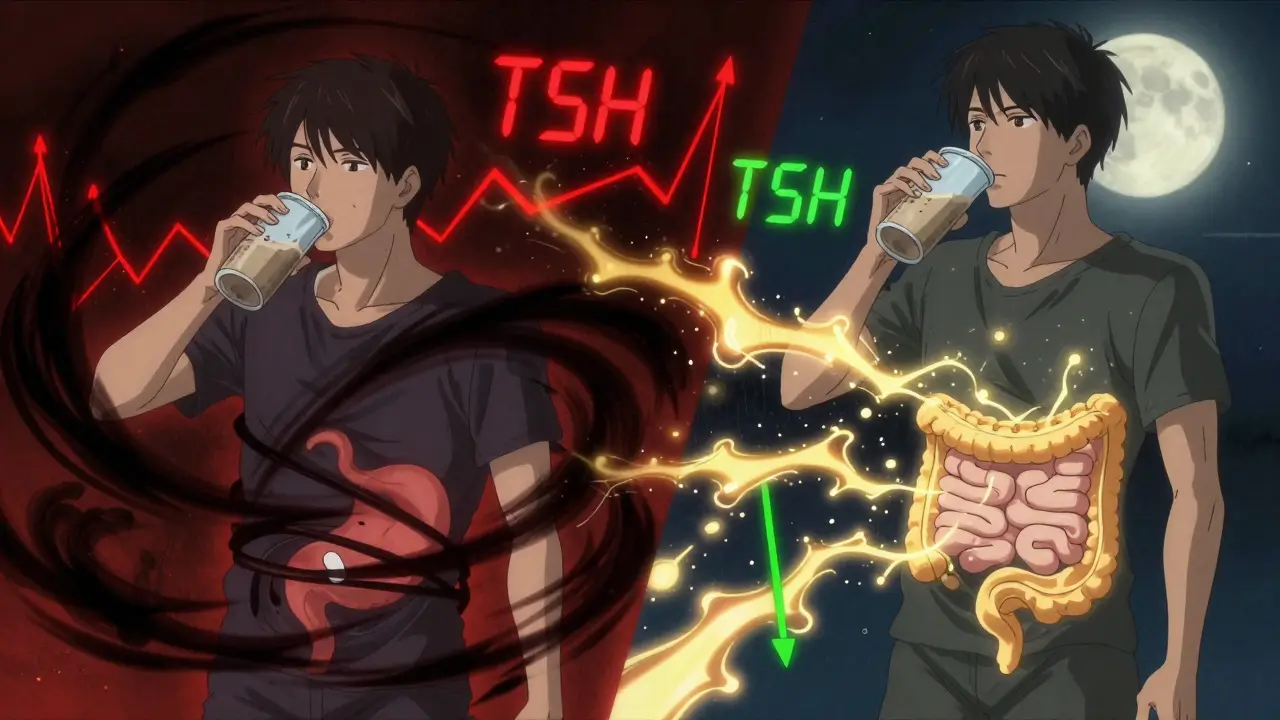
Levothyroxine doesn’t just float through your gut and get absorbed. It needs a clear, empty path. The drug is absorbed mostly in the upper part of your small intestine, and anything that slows down digestion or binds to the hormone can block it. Protein shakes-especially those with whey-do exactly that. They delay gastric emptying, meaning your stomach takes longer to send the pill on its way. A 2018 study in the Journal of Nutritional Science showed whey protein can slow this process by up to 30%. That’s enough to throw off absorption.Many protein shakes also contain added calcium, iron, or magnesium. These minerals are notorious for binding to levothyroxine like glue. A 2022 clinical guideline from the American Association of Clinical Endocrinologists found that calcium-fortified shakes can reduce absorption by up to 25%. One case study in BMJ Case Reports tracked a woman whose TSH spiked from 1.8 to 15.2 after she started drinking a whey protein shake 30 minutes after her pill. Her dose didn’t change. Her routine did. And once she waited four hours, her levels normalized.
The 4-Hour Rule: What the Science Says
The gold standard isn’t 30 minutes. It’s not even an hour. It’s four hours. That’s the window recommended by the American Thyroid Association, the Endocrine Society, and multiple peer-reviewed studies. Why so long? Because even after you’ve eaten, your gut is still busy. Levothyroxine needs a quiet, uninterrupted ride to be absorbed properly.Here’s how it breaks down:
- Take your levothyroxine first thing in the morning, with a full glass of water, on an empty stomach.
- Wait at least 60 minutes before eating or drinking anything else.
- Then wait another 3 hours before having your protein shake.
That’s a total of four hours. No shortcuts. No exceptions. A 2021 meta-analysis in the Journal of Clinical Endocrinology & Metabolism found that patients who followed this rule had significantly more stable TSH levels than those who didn’t. Even a 2-hour gap led to measurable drops in free T4 levels in 68% of patients surveyed in the r/Hashimotos community.
Morning vs. Evening Dosing: Which Works Better?
Most people take levothyroxine in the morning because it’s been the standard for decades. But here’s the twist: evening dosing might actually be better if you’re a protein shake drinker.A 2021 study of over 1,200 patients found that those who took their pill at night-4 hours after dinner-had 13.8% higher free T4 levels and 27.6% lower TSH than morning takers. Why? Because your digestive system slows down at night. More time for absorption. Fewer interruptions.
And here’s the kicker: if you take your protein shake at breakfast, you can still take levothyroxine at night without conflict. You’re not giving up your routine-you’re just shifting it. A 2020 trial with 187 patients showed evening dosing worked just as well as morning dosing, as long as the 4-hour gap was respected.
Still, 78.5% of people stick with morning dosing. Why? Habit. Convenience. But if your TSH won’t budge, and you’re drinking protein shakes at 7 a.m., your schedule might be the problem-not your medication.
What About Other Protein Sources?
Not all protein is created equal when it comes to thyroid interference. Whey protein is the worst offender. It’s fast-digesting, high in calcium, and packed with amino acids that interfere with thyroid hormone transporters in the gut.But pea protein? Different story. A 2023 study in the European Journal of Endocrinology found that pea protein caused only a 12.3% reduction in absorption-less than half the impact of whey. If you’re stuck with a morning shake and can’t wait four hours, switching to pea, rice, or soy protein might help. It’s not a perfect fix, but it’s a step in the right direction.
Also, avoid protein bars. They often contain calcium, iron, and fiber-all of which can bind to levothyroxine. Stick to liquid shakes if you must, and always check the label for added minerals.
Real People, Real Results
It’s not just theory. Real people are fixing their thyroid levels by changing their timing.One Reddit user, u/HypothyroidWarrior, had been taking Synthroid for eight years. Her TSH kept climbing. Her doctor kept increasing her dose. She thought it was stress, or her diet, or her age. Then she read about the protein shake connection. She moved her shake to lunchtime and took her pill at night. Within three months, her TSH dropped from 11.4 to 2.1-without changing her medication.
Another patient on ThyroidChange.com had gone through two dose increases in 18 months because she was taking her shake 30 minutes after her pill. Once she waited four hours, her levels stabilized. She didn’t need more pills. She just needed better timing.
These aren’t outliers. A 2022 study of 342 patients showed that 73.2% reached stable thyroid levels within 8-12 weeks when they followed strict timing rules. Only 41.5% did so with inconsistent dosing.
What to Do If You Can’t Wait Four Hours
Life isn’t perfect. Maybe you’re rushing to work. Maybe you’re hungry. Maybe your gym class starts at 6 a.m. Here’s what you can do:- Switch to evening dosing. Take your pill 4 hours after dinner. No food, no coffee, no supplements. This is the most reliable workaround.
- Swap whey for pea protein. Less interference. Less risk. Still gets the job done.
- Drink water or herbal tea in the morning. No caffeine, no sugar, no calcium. Just plain water. It won’t interfere.
- Use a pill organizer with alarms. Apps like ThyroidManager Pro (version 3.2, 2024) let you log your medication and supplements and send reminders when it’s safe to eat.
And if you’re still unsure? Get your TSH tested every 6-8 weeks after changing your routine. Your doctor can tell you if the timing is working.
What the Industry Is Doing About It
The problem is growing. In 2023, over 121 million prescriptions for levothyroxine were filled in the U.S. And the global protein supplement market hit $23.5 billion. Millions of people are mixing the two-and most don’t know the risks.Pharmaceutical companies are catching on. Synthroid’s 2023 patient leaflet now explicitly warns about protein supplements. Supplement brands like Optimum Nutrition added warnings to their labels in 2022: “Consult your physician if taking thyroid medication.” The FDA issued a safety alert in March 2023 requiring clearer interaction warnings on packaging.
But education still lags. A 2023 study found that 38.6% of gym-goers with hypothyroidism had never heard of this interaction. That’s not their fault. It’s a system failure.
Final Takeaway: You Don’t Have to Quit Protein
You don’t need to give up your protein shakes. You don’t need to stop working out. You don’t need to feel guilty for wanting to fuel your body.You just need to space it out.
Take your levothyroxine on an empty stomach. Wait four hours. Then have your shake. Or switch to nighttime dosing. Either way, your thyroid will thank you.
Stable TSH. Better energy. Fewer dose changes. All from a simple change in timing. That’s the power of science-simple, clear, and doable.


