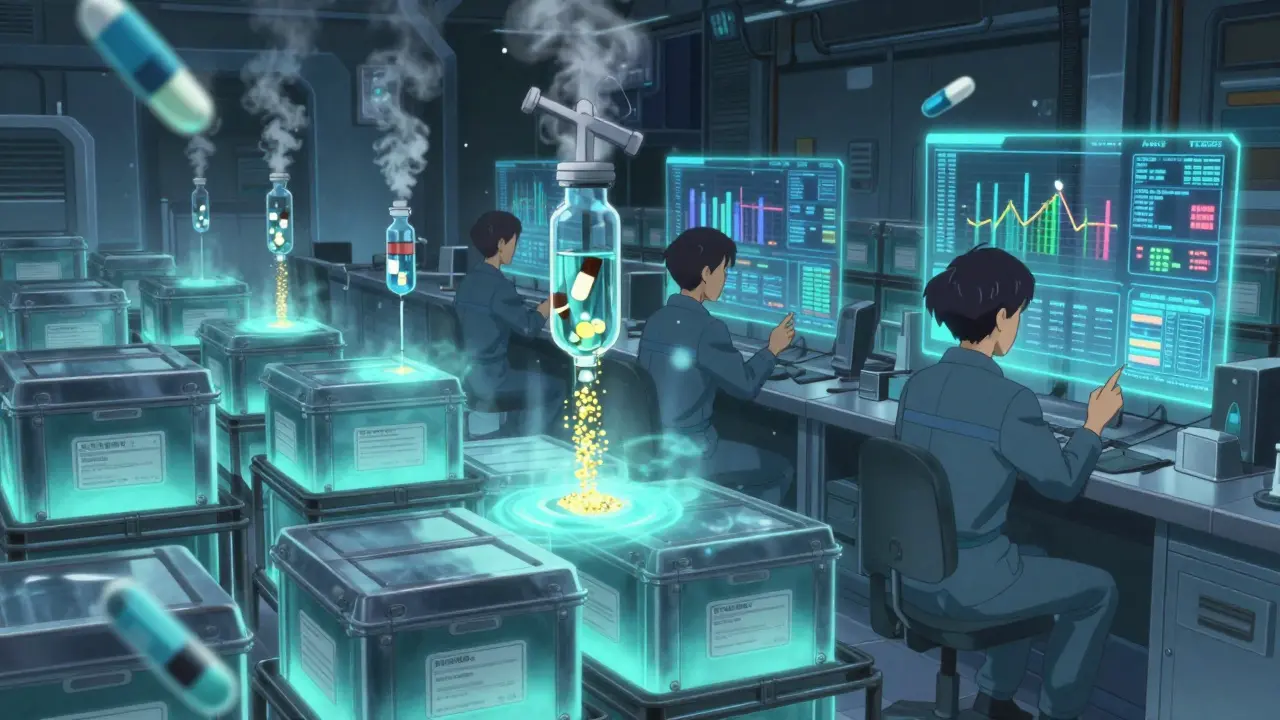
Most people think that when a pill hits its expiration date, it’s no longer safe or effective. That’s what the label says, after all. But what if that date was never meant to be a hard stop - just a conservative guess? The U.S. Military’s Shelf-Life Extension Program (SLEP) proves it. Since 1986, the Department of Defense and the FDA have been testing stockpiled medications years after their labeled expiration dates. The results? Many drugs remain potent, safe, and usable - sometimes for over a decade past their printed date.
How SLEP Works: Testing Beyond the Label
SLEP isn’t about guessing. It’s about science. Every few years, the FDA takes samples from federally stored medications - antibiotics, painkillers, antivirals, epinephrine - and tests them under strict lab conditions. These aren’t random pills from a pharmacy shelf. They’re stored in climate-controlled warehouses, sealed in original packaging, kept away from light and moisture. That’s key. The program only tests drugs that have been stored properly.To qualify for an extension, a drug must still contain at least 85% of its original active ingredient. That’s not a loose standard. It’s the same level of potency required when the drug was first approved. If it hits that mark, the FDA extends its shelf life - often by two to three years. In some cases, it’s been extended by more than 15 years.
The process is methodical. Each lot of medication is tracked. Testing cycles happen every one to three years, depending on the drug’s history. The DoD’s Shelf Life Extension System (SLES) keeps all the records. Access isn’t open to the public - only authorized military and federal personnel can check the Quality Status List. But the data is there, and it’s reliable.
What the Numbers Say
The evidence speaks loudly. A 2006 study in the Journal of Pharmaceutical Sciences tested 122 drugs from federal stockpiles. Eighty-eight percent of them were still effective beyond their expiration dates. Some were over 15 years past their label. That’s not an outlier. It’s the norm.Between 2005 and 2015, SLEP saved the federal government an estimated $2.1 billion. That’s money not spent replacing perfectly good drugs. In 2019 alone, the program extended the shelf life of oseltamivir (Tamiflu) by three years - preserving 22 million treatment courses for a potential flu pandemic. The Army Medical Logistics Support Activity reported a 42% drop in pharmaceutical waste after implementing SLEP. Military treatment facilities that followed the program closely cut waste by 38%, saving about $87 million a year.
By 2022, over 2,500 different drugs had received shelf-life extensions through SLEP. That’s up from just 150 in 2000. The growth rate? Nearly 15% per year. And it’s not slowing down. The 2023 National Defense Authorization Act added new medical countermeasures for chemical and biological threats to the program, with plans to expand further.
Why Commercial Drugs Are Treated Differently
Here’s the twist: you won’t see this kind of testing in your local pharmacy. Why? Because the rules are different.Pharmaceutical companies set expiration dates based on accelerated stability testing - a process that simulates years of aging in a matter of months. These tests are designed to be cautious. They’re not meant to find the true limit. They’re meant to guarantee safety under real-world conditions: a medicine cabinet in a hot bathroom, a car glovebox in summer, or a backpack left in the sun. The 2- to 3-year expiration date you see on your bottle? It’s not the drug’s actual end-of-life. It’s a safety buffer.
That’s why SLEP’s findings can’t be directly applied to consumer medications. The FDA is clear: extensions under SLEP apply only to the exact lot, packaging, and storage conditions tested. You can’t take a 10-year-old bottle of ibuprofen from your medicine cabinet and assume it’s still good just because the military says some drugs last longer.
But here’s what SLEP does show: expiration dates are not a scientific truth. They’re a regulatory standard built on caution, not evidence. And for stockpiled drugs - where storage is controlled and access is critical - that caution can be relaxed without risk.
What This Means for the Future of Medicine
SLEP has changed how scientists think about drug stability. Dr. Lawrence Yu, former deputy director at the FDA’s Center for Drug Evaluation and Research, said it best: “The data from SLEP has fundamentally changed our understanding of drug stability in properly stored conditions.”Now, the FDA is using SLEP data to rethink how expiration dates are set for new drugs. Advanced testing methods - like mass spectrometry and predictive modeling - are being explored to create more accurate, less conservative labels. The goal? Reduce waste without compromising safety.
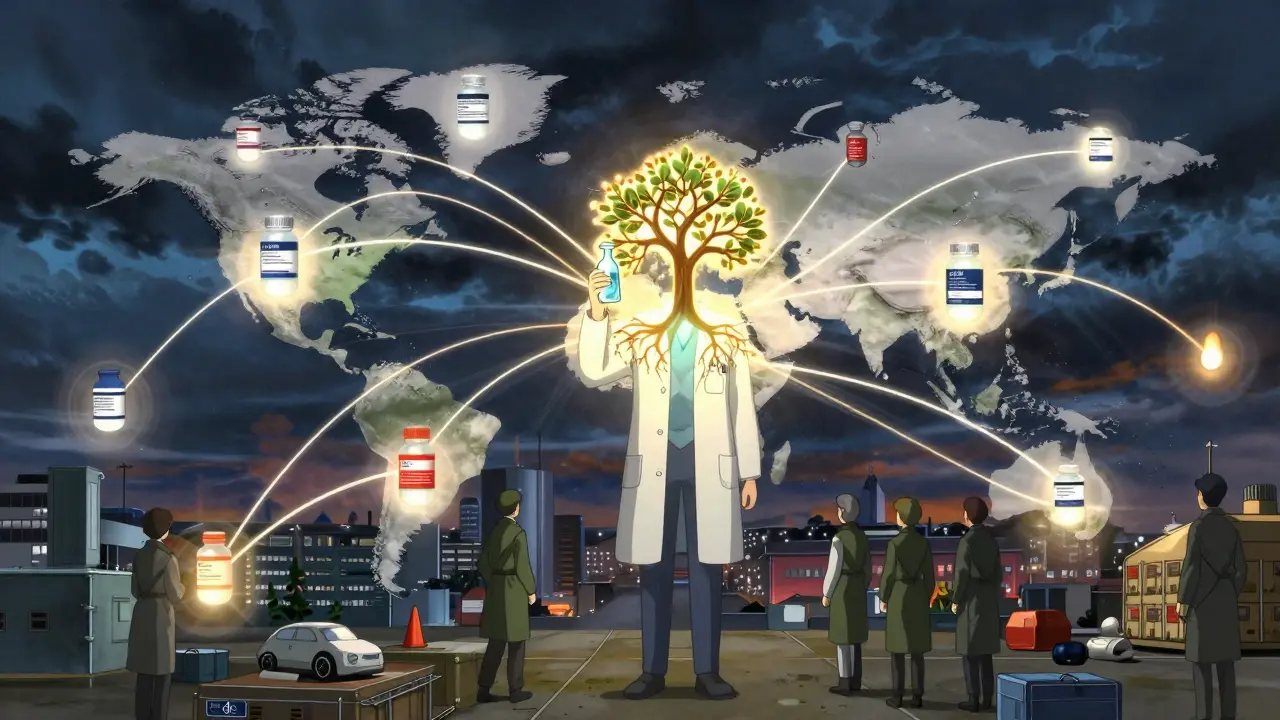
Even NATO countries have taken notice. Since 2010, 12 allied nations have built their own shelf-life extension programs based on the U.S. model. They’re not just saving money - they’re ensuring that in a crisis, life-saving drugs are still available.
And while critics like Dr. Michael D. Swartzburg warn against generalizing SLEP’s results to all drugs or all storage environments, even he agrees: “The program is scientifically sound for its intended purpose.”
The Real Cost of Ignoring Stability Data
Every year, Americans throw away about $1.7 billion worth of expired medications. Most of it is perfectly usable. Hospitals, pharmacies, and households toss out pills, syringes, and inhalers because they’re “expired.” But if we applied even a fraction of SLEP’s rigor to civilian supply chains, we could cut that waste dramatically.Imagine if long-term care facilities, disaster response teams, or rural clinics had access to verified, extended-life medications. In a pandemic, a natural disaster, or a supply chain breakdown, that could mean the difference between life and death.
SLEP proves that expiration dates are not the whole story. They’re a starting point - a conservative estimate made under imperfect conditions. When you control the environment, drugs last far longer than we assume. The military doesn’t just save money. It saves lives by trusting science over labels.
What’s Next for SLEP?
The program is evolving. In 2021, it expanded to include certain biological products - like vaccines and antitoxins - though they still make up only about 5% of total extensions. A new electronic data system, rolled out in late 2022, cut extension approval times from 14 months to just over 8. That’s a game-changer for rapid response.But challenges remain. The 2023 Congressional Budget Office estimated that full expansion of SLEP to cover all emerging threats would require an extra $75 million per year. That’s a lot - but it’s less than the $210 million the program already saves annually.
Training is another hurdle. A 2018 survey found that 35% of military logistics staff struggled to access up-to-date SLES records due to complex authentication systems. Fixing that could unlock even more savings.
The FDA’s 2022-2026 Strategic Plan lists expanding shelf-life science as a top priority. That means more research, better tools, and possibly - someday - more accurate expiration dates for everyone.
What You Can Learn From SLEP
You might never get a government-approved extension for your leftover antibiotics. But you can still learn from SLEP.First: don’t panic when a pill expires. If it’s been stored properly - cool, dry, dark - it’s likely still effective. The FDA itself says most expired medications lose little to no potency.
Second: expiration dates aren’t safety deadlines. They’re manufacturer guarantees. If you’re unsure, consult a pharmacist. Don’t just toss it.
Third: the real problem isn’t drug instability. It’s our mindset. We treat expiration dates like a law, not a guideline. SLEP shows us that’s not how science works.
Medicines aren’t like milk. They don’t spoil the same way. They degrade slowly - if at all - under the right conditions. The military has spent 40 years proving it. Now it’s time the rest of us caught up.
Are expired medications dangerous to take?
Most expired medications are not dangerous - they just lose potency over time. The FDA states that very few drugs become toxic after expiration. The main risk is reduced effectiveness, especially for critical drugs like epinephrine or insulin. For non-critical medications like pain relievers or antihistamines, taking them shortly after expiration is usually safe, but not guaranteed to work.
Why do drug companies set such short expiration dates?
Drug companies use accelerated testing to predict stability under real-world conditions - like heat, humidity, and light exposure. These tests are designed to be conservative to ensure safety and avoid liability. A 2- to 3-year expiration date is often chosen because it’s easy to manage and covers worst-case scenarios. It’s not based on how long the drug can actually last, but on what the company can guarantee under imperfect storage.
Can I use military shelf-life extension data for my own medications?
No. SLEP extensions apply only to specific lots tested under strict military storage conditions. The same drug in your home medicine cabinet, exposed to temperature swings and moisture, may degrade faster. The FDA explicitly warns against applying SLEP results to personal use. Always follow the label unless advised otherwise by a licensed pharmacist or doctor.
How does SLEP ensure the safety of extended drugs?
SLEP uses rigorous lab testing: each drug lot is sampled and analyzed for potency, purity, and chemical breakdown. The FDA requires at least 85% of the original active ingredient to remain. Only drugs that pass this threshold get an extension. Storage conditions are also tracked - temperature, humidity, packaging integrity - to ensure the drug hasn’t been compromised. Every extension is documented and tied to a specific lot number.
Has any country other than the U.S. adopted a similar program?
Yes. Since 2010, 12 NATO allies - including Canada, Germany, and the United Kingdom - have created their own shelf-life extension programs modeled after SLEP. These programs help nations maintain medical countermeasures without the high cost of constant replacement. The U.S. program remains the most comprehensive, but others are catching up, especially for pandemic and bioterror preparedness.


