Every year, millions of people buy medication online. Some of them get the right pills. Others get fake ones - pills with no active ingredient, wrong dosages, or even toxic chemicals. The FDA estimates that 1-3% of the $575 billion U.S. prescription drug market comes from illegal online pharmacies. That’s billions of dollars in dangerous products slipping through the cracks. And it’s not just about money. It’s about your life.
How do you know if the pharmacy you’re using is real? A licensed pharmacy isn’t just a website with a nice logo. It’s a business that has passed strict checks, employs certified pharmacists, and follows state and federal laws. If you’re buying medication - whether it’s for high blood pressure, diabetes, or anxiety - you need to make sure the pharmacy is legitimate. Here’s how.
What Makes a Pharmacy Licensed?
A licensed pharmacy doesn’t just exist online. It’s registered with a state board of pharmacy. In the U.S., each state has its own board that issues licenses. These boards don’t just check paperwork. They inspect facilities, review pharmacist credentials, and monitor how drugs are stored and dispensed.
To get licensed, a pharmacy must have at least one pharmacist-in-charge who has passed the North American Pharmacist Licensure Examination (NAPLEX). That’s a tough test - you need a score of at least 75 out of 150. Many states also require a second exam on local pharmacy laws, like California’s CPJE. The pharmacy itself must prove it has secure storage, proper recordkeeping, and a physical address where inspections can happen.
It’s not enough to say you’re a pharmacy. You have to prove it. And you have to keep proving it. Licenses aren’t permanent. They expire. Renewals cost between $100 and $409 a year, depending on the state. In California, for example, the fee is $409 as of 2024. If a pharmacy stops paying, its license becomes inactive. That means it’s no longer legal to operate.
The NABP Verify Program: Your First Line of Defense
The National Association of Boards of Pharmacy (NABP) runs the most trusted verification system in the country. NABP doesn’t issue licenses - state boards do. But NABP collects and cross-checks license data from all 50 states and territories. Their NABP Verify tool lets you search for a pharmacy by name, address, or license number and see its real-time status.
As of 2023, NABP Verify had access to data from 66,000 licensed pharmacies across the U.S. And here’s the key: if a pharmacy’s license is suspended, revoked, or under investigation, NABP updates that status within 24 hours. That’s faster than most state websites. The service costs $125 a year for professionals, but consumers can use it for free.
Don’t confuse NABP Verify with other seals. Some fake pharmacies slap on logos that look like NABP’s. But only the official NABP Verify portal gives you live, government-backed data. Go to www.nabp.pharmacy/verify and search. If the pharmacy doesn’t show up - or says “inactive” - walk away.
How to Spot a Fake Online Pharmacy
Illegitimate pharmacies are getting smarter. They use professional websites, fake reviews, and even mimic the look of big-name retailers. But they still leave traces. Here are five red flags:
- No prescription required. Legitimate pharmacies in the U.S. require a valid prescription for controlled substances and most prescription drugs. If a site lets you buy oxycodone or Adderall without a prescription, it’s illegal.
- No physical address or vague location. Check the address on Google Maps. If it’s a PO box, a residential street, or a building with no pharmacy sign, that’s a warning. Real pharmacies have storefronts or licensed distribution centers.
- No licensed pharmacist available. A real pharmacy must have a pharmacist on call to answer questions. If you can’t find a phone number or live chat option for a pharmacist, it’s not legitimate.
- Too-good-to-be-true prices. If a $300 insulin pen is being sold for $30, it’s not a discount - it’s a trap. Counterfeit drugs often cost less because they’re made in unregulated labs with cheap, unsafe ingredients.
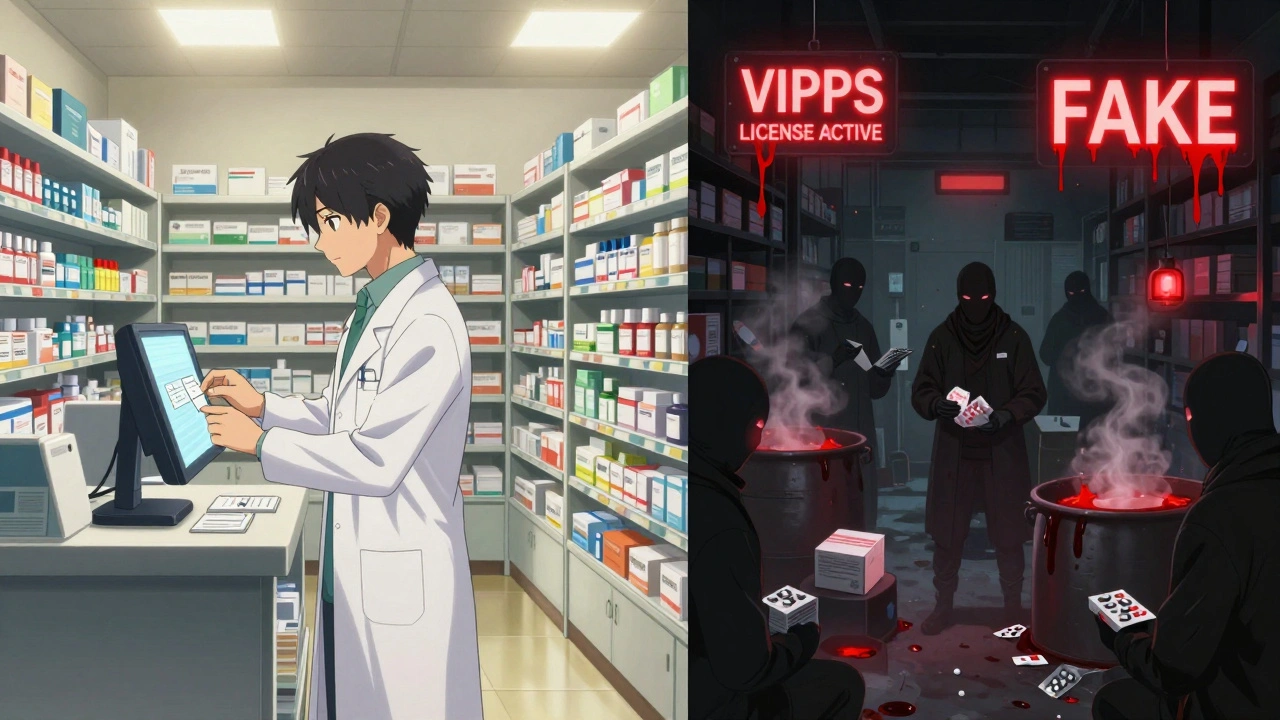
- Fake accreditation seals. Look closely at any “VIPPS” or “NABP Verified” logos. Click on them. If they don’t link to the official NABP site, they’re fake. The FDA found that 1 in 4 counterfeit pharmacy sites use fake seals to trick people.
Use the FDA’s Five-Step Verification Process
The FDA has a simple, five-step checklist that works for anyone - whether you’re buying for yourself, a parent, or a pet.
- Check for a valid prescription. No prescription? No deal. Even if the site claims it’s “over-the-counter,” most prescription drugs aren’t sold legally without one.
- Verify the physical address. Type the pharmacy’s address into Google Maps. Look for a storefront, parking lot, or delivery van with the pharmacy’s name. If it’s a warehouse with no signage, move on.
- Search the state board website. Go to your state’s board of pharmacy site. In California, it’s www.pharmacy.ca.gov. Enter the license number - but only the number, not the prefix. If the site says “inactive,” “suspended,” or “revoked,” stop.
- Confirm pharmacist availability. Legitimate pharmacies must have a pharmacist available by phone or chat. Call them. Ask a question about your medication. If they can’t answer, or if you get an automated voicemail, that’s a red flag.
- Look for VIPPS accreditation. The Verified Internet Pharmacy Practice Sites (VIPPS) program is the gold standard for online pharmacies. Only about 1,000 U.S. pharmacies have this seal. You can check the list at www.nabp.pharmacy/vipps.
A 2023 University of Florida study found that 92% of people could complete these steps in under five minutes. The hardest part? Knowing where to look. Most people stop at Step 1 - and that’s where the scams win.
Real Stories: When Verification Saved Lives
In March 2024, Maria Chen from Los Angeles ordered her blood pressure medication from a new online pharmacy. She noticed the price was 60% lower than her usual pharmacy. She didn’t assume it was a deal. She checked the license number on the California Board of Pharmacy website. The result: the pharmacist-in-charge had resigned six months earlier, and the license was under review. She canceled the order. Later, she learned the pharmacy had been flagged for dispensing expired pills.
Another case from the Better Business Bureau involved a woman in Texas who lost $850 to a site that looked just like a real pharmacy. It had a professional logo, customer testimonials, and even a “NABP Verified” badge. But when she clicked the badge, it led to a copied page. The real NABP site showed no record of that pharmacy. She reported it to the FDA. The site was shut down within weeks.
These aren’t rare. In 2023, the FDA took action against 1,200 unlicensed online pharmacies - up 22% from the year before. Most of them were selling fake versions of popular drugs like metformin, lisinopril, and azithromycin.
What About Multi-State Pharmacies?
If you live in one state but buy from a pharmacy in another, things get trickier. A pharmacy in Florida can ship to California - but only if it’s licensed in both states. That’s where the Verified Pharmacy Program (VPP) comes in. Launched in 2020, VPP lets pharmacies apply once for multi-state operations. But it’s not free. Setup costs average $1,850, and pharmacies must pass inspections in every state they serve.
As of December 2023, only 312 pharmacies were enrolled in VPP - covering 1,872 locations. That’s less than 1% of all U.S. pharmacies. So if you’re buying from a pharmacy outside your state, make sure it’s licensed in your state too. Don’t assume it’s okay just because it’s licensed somewhere else.
What’s Changing in 2024 and Beyond
The system is improving - slowly. In January 2024, California started requiring out-of-state pharmacies shipping to residents to provide an 800-number for direct pharmacist access. The FDA has also launched a $15 million initiative to detect fake online pharmacies using AI and data tracking. By 2026, they aim to cut consumer harm from unverified pharmacies by 40%.
NABP’s InterConnect system, rolled out in early 2024, now links 43 states in real time. That means if a pharmacy’s license is revoked in Texas, it’s instantly flagged in New York. But 7 states still haven’t joined. And some states still require fingerprint background checks ($65+), while others accept online checks ($35). The inconsistency frustrates even professionals.
Experts predict that by 2027, the U.S. will move toward national licensure standards - cutting down the current confusion. But until then, you can’t rely on automation. You have to do the work.
Final Checklist: Is Your Pharmacy Legit?
Before you click “buy,” ask yourself these five questions:
- Does this pharmacy require a valid prescription?
- Can I find a real, verifiable physical address?
- Can I speak to a licensed pharmacist?
- Is the license active on my state’s board of pharmacy website?
- Does the NABP Verify tool show this pharmacy as licensed?
If you answer “yes” to all five, you’re probably safe. If you’re unsure - stop. Call your doctor. Ask your local pharmacy. Or visit a brick-and-mortar store. There’s no shortcut to safety.
Counterfeit drugs don’t just waste money. They can kill. A single fake pill of fentanyl can be lethal. A wrong dose of insulin can send someone into a coma. You don’t need to be a pharmacist to protect yourself. You just need to know where to look - and the courage to check.
How do I know if my pharmacy is licensed?
Check your state’s board of pharmacy website. Enter the pharmacy’s license number (not the prefix) or its name. If the status says “active,” it’s licensed. You can also use the NABP Verify tool at www.nabp.pharmacy/verify to check across all U.S. states.
Can I trust online pharmacies that offer cheap medication?
No. If the price seems too good to be true - like insulin for $10 or Adderall for $5 per pill - it’s likely counterfeit. Legitimate pharmacies follow regulated pricing. Fake ones cut corners with unsafe ingredients. The FDA has found that 98.7% of unverified online pharmacies sell fake drugs.
What’s the difference between VIPPS and NABP Verify?
NABP Verify confirms if a pharmacy holds a valid state license. VIPPS is a voluntary accreditation program that adds extra standards - like requiring a pharmacist to be on-site during business hours and using secure, encrypted systems for prescriptions. VIPPS-certified pharmacies are the safest option for online orders.
Are international pharmacies safe to use?
Most are not. The FDA does not approve pharmacies outside the U.S. to sell prescription drugs to Americans. Even if they claim to be “licensed” in Canada or India, those licenses don’t apply in the U.S. And many international sites are fronts for counterfeit operations. Stick to U.S.-based, licensed pharmacies.
What should I do if I bought medicine from a fake pharmacy?
Stop taking the medication immediately. Contact your doctor to discuss potential risks. Report the pharmacy to the FDA at www.fda.gov/reportbadmed or call 1-800-FDA-1088. You can also file a complaint with the FTC at ReportFraud.ftc.gov. Keep the packaging and receipt - they help investigators track down the operation.


