Language Access Calculator
Pharmacy Language Compliance Calculator
Calculate which languages must be supported based on the 1% rule (federally required minimum for pharmacy services).
How This Works
According to federal law (Section 1557 of the Affordable Care Act), pharmacies must provide services in languages spoken by 1% or more of the local population. This calculator helps you determine which languages meet this requirement based on your community's demographics.
Imagine you just got a new prescription. The pharmacist hands you the bottle, but the instructions are in a language you don’t understand. You nod along, smile, and leave-only to take the wrong dose days later because you thought "twice daily" meant "after breakfast and dinner." This isn’t rare. It’s happening to millions of people in the U.S. every year. For those with Limited English Proficiency (LEP), medication errors aren’t accidents-they’re systemic failures. And the law is finally catching up.
Why Language Access Isn’t Optional
Federal law now requires all healthcare providers that get federal funding-including pharmacies-to give patients clear, accurate information about their medications in a language they understand. This isn’t just good customer service. It’s a legal requirement under Section 1557 of the Affordable Care Act, which was strengthened on July 5, 2024. The goal? Stop preventable harm. Studies show that when patients don’t understand how to take their meds, they’re far more likely to overdose, skip doses, or mix dangerous combinations. One study found that nearly one-third of adverse drug events among non-English speakers happened because of poor communication.It’s not just about safety. It’s about dignity. No one should have to rely on their 12-year-old child or a neighbor who barely speaks English to explain how to use life-saving drugs. That’s why the law bans providers from forcing patients to use family members as interpreters-unless the patient asks for it.
What the Law Actually Demands
In states like New York and California, the rules are especially clear. Pharmacies must do more than just hang up a sign. They must:- Provide free, real-time interpretation for medication counseling-by phone, video, or in person
- Translate all written materials: prescription labels, warning labels like "May cause drowsiness," and patient information sheets
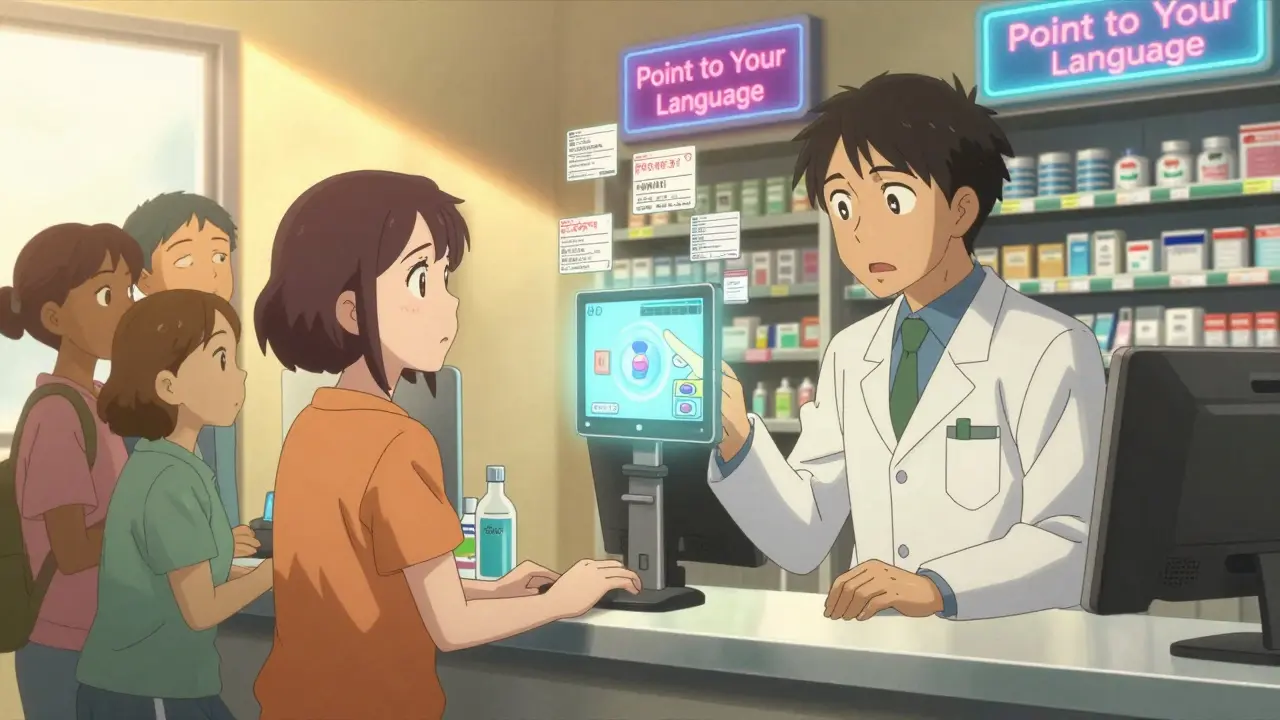
- Display visible signs near the counter that say "Point to your language"-in multiple languages
- Record each patient’s preferred language in their profile
- Offer services even if the patient doesn’t ask-staff must proactively offer help
These aren’t suggestions. They’re enforceable rules. The New York State Attorney General’s office issued 147 citations in 2022 alone-mostly for missing signs or staff who didn’t offer interpretation. One pharmacy was fined for having a "Point to your language" poster… but no one knew how to activate the phone interpreter service.
Who Gets Covered? The 1% Rule
The law doesn’t require every pharmacy to offer 20 languages. Instead, it uses a simple threshold: if a language is spoken by 1% or more of the local population, the pharmacy must provide services in that language. In New York City, that means Spanish, Chinese, Bengali, Russian, Arabic, Haitian Creole, and Korean are mandatory. In smaller towns, it might be just one or two. The maximum number of languages a pharmacy must support at once is seven, based on U.S. Census data.But here’s the catch: demographics change. A neighborhood that was mostly Spanish-speaking five years ago might now have large populations of Ukrainian or Somali speakers. The current system doesn’t update fast enough. Some experts say the seven-language cap leaves gaps. One pharmacy owner in Queens told a reporter, "We have 12 languages spoken in our zip code. We can’t afford to hire interpreters for all of them."
How Pharmacies Are Meeting the Requirements
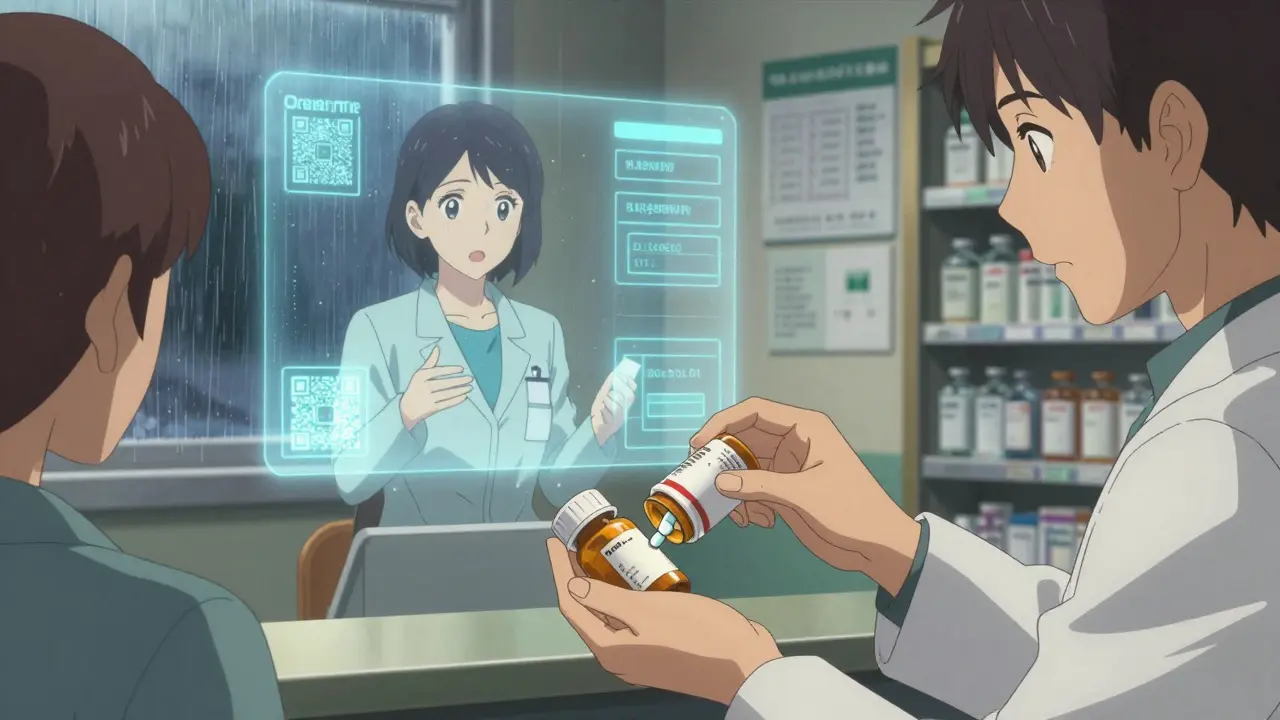
Big chains like CVS and Walgreens have invested heavily. They use contracted services like LanguageLine Solutions and TransPerfect to connect patients with professional interpreters over the phone or video. Staff get 10 hours of mandatory training on how to use the systems, how to recognize when someone needs help, and how to avoid cultural misunderstandings. Many now have QR codes on signs that link directly to video interpreter portals.Independent pharmacies struggle more. About 67% of them have fully compliant systems-compared to 92% of chains. Cost is the biggest barrier. Hiring in-house interpreters isn’t feasible for most. But using phone services costs less than $2 per call. The federal government even runs a free help desk (1-800-688-8814) to guide small pharmacies through compliance.
Real Impact: Stories From the Front Lines
In the Bronx, a pharmacist named Maria told Reddit users that since implementing full language access, her team hasn’t had a single medication error linked to language in over two years. "We serve Bengali, Spanish, and Arabic speakers daily," she wrote. "Now, when someone looks confused, we don’t guess. We press a button and get a live interpreter in seconds." On Yelp, patients are noticing. Chain pharmacies in NYC average 4.2 out of 5 stars for language services. One review said: "Finally, someone at the pharmacy spoke my language. I didn’t have to panic when I didn’t understand the label." But problems remain. A Chinese-speaking patient in Queens wrote on Google Reviews: "They have the sign. But when I pointed to Chinese, no one knew what to do. I waited 20 minutes." The disconnect isn’t always about resources-it’s about training. Some staff still think "offering" help means asking, "Do you need an interpreter?" instead of saying, "I’ll get you someone right now."
What Patients Should Expect
If you or someone you care for has limited English skills, here’s what you’re entitled to:- Immediate access to a qualified interpreter-no waiting, no asking twice
- Written instructions in your language-on the bottle, on the bag, on the sheet
- No pressure to use family members as interpreters
- Staff who proactively offer help, not just wait for you to ask
- Signage you can understand-"Point to your language" should be visible and clear
If you’re denied any of this, you have rights. You can file a complaint with the U.S. Department of Health and Human Services Office for Civil Rights. Or, in New York, contact the State Office of Language Access Services. They’ll help you navigate the process.
The Bigger Picture: Safety, Not Just Compliance
This isn’t just about legal boxes being checked. It’s about saving lives. A 2024 Congressional analysis found that these rules prevent about 14,000 dangerous drug events every year-saving $187 million in hospital costs. In New York City alone, medication-related ER visits among LEP patients dropped by 28% between 2010 and 2020.And the changes are still coming. The FDA is working on standardized pictograms for pill bottles-icons that show "take with food" or "avoid alcohol"-to help even when language isn’t perfect. AI translation tools are being tested, but regulators are clear: for medication instructions, human verification is still required. Machines can’t yet catch the nuance of "take one tablet by mouth twice a day" versus "take one tablet every 12 hours."
By 2026, every Medicare and Medicaid provider must be fully compliant. That includes community pharmacies, nursing homes, and home health services. The system is evolving-but the goal hasn’t changed: no one should die because they couldn’t understand their prescription.
Do I have to pay for an interpreter at the pharmacy?
No. By law, interpretation services for medication counseling must be free. Pharmacies cannot charge patients for interpreters, whether they’re in person, over the phone, or via video. This applies to all federally funded providers, including chain and independent pharmacies.
Can I use my child or friend as an interpreter?
You can ask to use them-but the pharmacy cannot require it. Federal law prohibits providers from forcing patients to use family members or friends as interpreters, especially for medical instructions. This is because untrained people often misinterpret critical details like dosage, timing, or side effects. Professional interpreters are trained in medical terminology and confidentiality.
What if the pharmacy doesn’t have my language on the sign?
Even if your language isn’t listed on the "Point to your language" sign, the pharmacy is still required to provide an interpreter if your language is spoken by 1% or more of the local population. Ask to speak to the manager. If they refuse, you can report them to your state’s Office of Language Access or the federal Office for Civil Rights. Many pharmacies can connect you via phone or video even if your language isn’t visibly posted.
Are translation apps allowed instead of interpreters?
No. While translation apps might help with simple phrases, they are not allowed for medication counseling. The law requires qualified human interpreters who understand medical terms like "hypotension," "contraindicated," or "take on an empty stomach." Apps can’t interpret context, tone, or safety warnings accurately. Even AI tools must be reviewed by a human before being used for medication instructions.
What should I do if the pharmacist won’t help me?
Politely ask to speak to the pharmacy manager. If they still refuse, write down the date, time, location, and what happened. Then call the federal Language Access Help Desk at 1-800-688-8814 or file a complaint with the U.S. Department of Health and Human Services Office for Civil Rights. You can also contact your state’s health department. These complaints trigger investigations-and pharmacies that ignore the law face fines.


