
When your kidneys aren’t working well, even healthy foods can become dangerous. For people with chronic kidney disease (CKD), high potassium levels-called hyperkalemia-can strike without warning and lead to heart rhythm problems, muscle weakness, or even sudden cardiac arrest. It’s not rare: up to half of people with advanced CKD have elevated potassium, and it’s one of the top reasons doctors adjust or stop life-saving heart and kidney medications. But here’s the good news: with the right diet, monitoring, and newer medications, you can keep potassium in a safe range without giving up all the foods you love-or stopping your essential treatments.
Why Potassium Becomes a Problem in CKD
Your kidneys normally filter out extra potassium from your blood. But when kidney function drops-especially in stages 3b to 5-your body can’t clear it fast enough. Potassium builds up slowly, often without symptoms at first. By the time you feel tingling, fatigue, or an irregular heartbeat, levels may already be dangerously high.Most people don’t realize that the drugs meant to protect their kidneys and heart-like ACE inhibitors, ARBs, and mineralocorticoid receptor antagonists (MRAs)-can actually raise potassium levels. These are called RAAS inhibitors, and they’re standard care for CKD because they slow disease progression and reduce heart risk. But they also block the body’s natural way of getting rid of potassium. So doctors face a tough choice: keep the heart-protecting drugs, or lower the dose and risk faster kidney and heart damage.
Studies show that when doctors reduce or stop RAAS inhibitors because of high potassium, patients face a 28% higher risk of heart events and a 34% higher chance their kidney disease will worsen. That’s why managing potassium isn’t about avoiding these drugs-it’s about finding ways to use them safely.
What’s a Safe Potassium Level?
Normal blood potassium is between 3.5 and 5.0 mmol/L. But for people with CKD, the goal isn’t just to stay under 5.0-it’s to stay between 4.0 and 4.5 mmol/L. Why? Because even levels just above 5.0 mmol/L increase the risk of abnormal heart rhythms. And once potassium hits 5.5 mmol/L or higher, emergency treatment is needed.ECG changes tell the story:
- Peaked T-waves at 5.5 mmol/L: early warning sign
- Widened QRS complex at 6.5 mmol/L: serious danger
- Flat P-waves or sine wave pattern above 7.0 mmol/L: cardiac arrest risk
These aren’t just numbers on a lab report-they’re signs your heart is under stress. That’s why regular blood tests are non-negotiable. If you start or increase a RAAS inhibitor, your doctor should check your potassium within 1 to 2 weeks. After that, every 3 to 6 months if you’re stable.
Dietary Limits: What You Can and Can’t Eat
Diet is the first line of defense. But it’s not about cutting out all potassium-rich foods-it’s about smart choices and portion control.For mild to moderate CKD (stages 1-3a), a “prudent but not restrictive” diet works best. That means avoiding extreme limits and focusing on balance. But if you’re in stage 3b or higher-especially if you’re not on dialysis-you need to aim for 2,000 to 3,000 mg of potassium per day. That’s about half of what most healthy adults eat.
Here’s what’s high in potassium and what to watch out for:
- Bananas: 422 mg per 100g → limit to half a banana
- Oranges and orange juice: 181 mg per 100g → avoid juice, limit whole fruit to one small orange
- Potatoes: 421 mg per 100g → leach them by soaking in water for 2+ hours before cooking
- Spinach, tomatoes, avocados, beans, nuts, dried fruit: all high → use small portions or swap for lower-potassium options
- Low-potassium swaps: apples, berries, cabbage, cauliflower, rice, pasta, white bread
Leaching potatoes and vegetables helps reduce potassium by up to 50%. Cut them into small pieces, soak in warm water for at least 2 hours, then rinse and cook in fresh water. It’s a small step, but it makes a big difference.
But here’s the hard truth: only about 37% of patients stick to these dietary rules long-term. Why? Because it’s isolating. Many patients say they feel left out of family meals, holidays, or social gatherings. A 2023 survey found that 45% of CKD patients reported social isolation because of their diet. That’s why dietitians now focus on flexibility-not perfection. It’s better to eat a small portion of a high-potassium food occasionally than to give up entirely and feel defeated.

Emergency Treatment: What Happens When Potassium Spikes
If your potassium hits 5.5 mmol/L or higher-and especially if you have ECG changes-you need immediate treatment. This isn’t something you can wait on.Emergency steps happen in order:
- Calcium gluconate (10 mL IV): given within minutes if you have heart rhythm changes. It doesn’t lower potassium-it protects your heart muscle from the effects of high potassium. Works in 1-3 minutes, lasts 30-60 minutes.
- Insulin and glucose (10 units insulin + 50 mL of 50% dextrose): lowers potassium by 0.5-1.5 mmol/L within 15-30 minutes. But it can cause low blood sugar in 10-15% of patients, so glucose is always given with it.
- Sodium bicarbonate (50-100 mmol IV): used only if you also have metabolic acidosis (low blood pH). Works in 5-10 minutes, but not effective if your acid levels are normal.
- Loop diuretics (like furosemide): help flush out potassium through urine-but they don’t work well if your eGFR is below 30. They’re not a reliable fix in advanced CKD.
These treatments buy time. They don’t remove potassium from your body-they just move it temporarily into your cells or protect your heart. To truly lower total body potassium, you need binders or dialysis.
Chronic Management: The New Generation of Potassium Binders
For long-term control, potassium binders are now standard. They work in your gut to trap potassium and flush it out in your stool. Three main types exist:- Sodium polystyrene sulfonate (SPS): the old standard. Takes 2-24 hours to work. But it’s risky: can cause colon damage (0.5-1% of users), and adds 11 mmol of sodium per gram-bad for people with heart failure or high blood pressure.
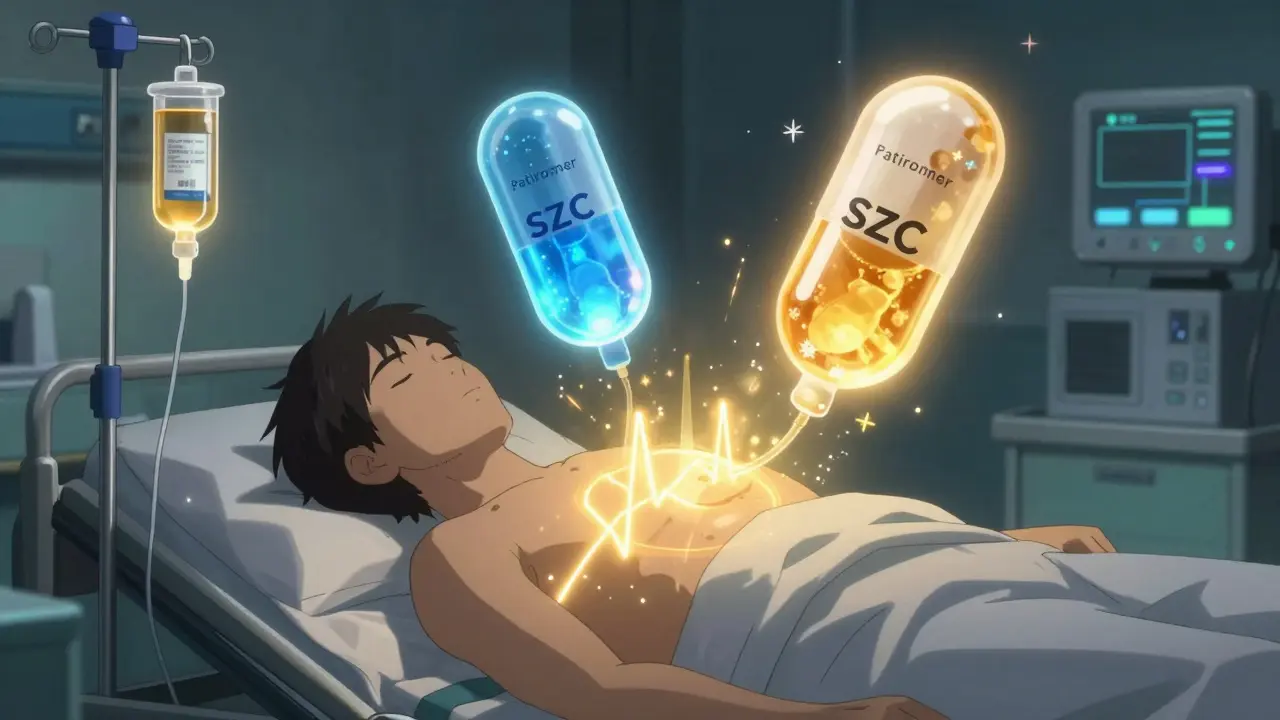
- Patiromer (Veltassa): approved in 2015. Works in 4-8 hours. Sodium-free, so safer for heart patients. But it can cause low magnesium (18.7% of users) and constipation (14.2%). Many patients find the chalky texture hard to swallow-22% quit because of taste.
- Sodium zirconium cyclosilicate (SZC, Lokelma): approved in 2018. Starts working in under an hour. Reduces potassium by 1.0-1.4 mmol/L in just 1 hour. But it adds sodium (1.2 g/day), which can worsen swelling in heart failure patients (12.3% vs. 4.7% with patiromer).
Which one is best? It depends on your situation:
- If you need fast correction (like after an emergency), SZC is preferred.
- If you have heart failure or need long-term use, patiromer is often better because it doesn’t add sodium.
- SPS is rarely used now unless cost is the only concern-it’s cheaper ($47/month) but far less safe.
The real win? These drugs let you stay on your RAAS inhibitors. In one study, 78% of patients on patiromer stayed on their full RAAS dose. Without binders, only 38% could. For SZC, 83% kept their heart medications going. That’s not just a lab improvement-it’s a life-saving one.
How to Stay on Track: Monitoring, Timing, and Support
Managing hyperkalemia isn’t just about pills and diet. It’s a system.Successful programs include:
- Regular potassium checks: every 3 months if stable, sooner if meds change
- Medication timing: patiromer can interfere with levothyroxine and other drugs. Take it at least 3 hours apart from other pills.
- Dietitian visits: a 60-minute initial session, then 30-minute follow-ups at 2 and 6 weeks
- Electronic alerts: many clinics now use EHR systems that flag potassium >5.0 mmol/L and auto-schedule a dietitian consult
Pharmacists also play a big role. CKD patients often take 7 or more medications. A pharmacist can spot interactions, like how SZC might affect blood pressure meds, or how patiromer lowers magnesium.
And now, digital tools are helping. Apps that scan food barcodes and calculate potassium content are showing a 32% improvement in diet adherence. If your clinic offers one, try it.
The Bigger Picture: Why This Matters
The global market for hyperkalemia treatments is growing fast-projected to hit $2.85 billion by 2030. Why? Because CKD is rising, and RAAS inhibitors are more widely used than ever. But behind the numbers are real people: patients who used to have to choose between heart protection and potassium safety.Today, that choice is fading. With better binders, smarter diets, and tighter monitoring, 85-90% of patients can now stay on their full RAAS doses. That means fewer heart attacks, slower kidney decline, and longer lives.
It’s not perfect. Cost is still a barrier. Patiromer costs over $600 a month in the U.S. SZC isn’t much cheaper. But the alternative-hospitalization for hyperkalemia-costs about $12,450 per admission. In the long run, the binders pay for themselves.
The future is even brighter. New drugs like tenapanor are in trials. Precision diets based on urine potassium levels are being tested. And by 2027, experts predict 75% of CKD patients on RAAS inhibitors will be on a potassium binder-making hyperkalemia a manageable side effect, not a deal-breaker.
What You Can Do Today
If you have CKD and are on RAAS inhibitors:- Ask for a potassium test if you haven’t had one in the last 3 months
- Ask your doctor if a potassium binder might help you stay on your current meds
- Meet with a renal dietitian-even one session can change how you eat
- Use a food-tracking app to log potassium intake
- Know your ECG warning signs: palpitations, dizziness, weakness
Hyperkalemia doesn’t have to mean giving up your health-or your life. With the right tools, you can keep your heart protected, your kidneys stable, and your meals enjoyable.
Can I still eat bananas if I have CKD?
Yes, but in small amounts. One small banana has about 422 mg of potassium. If you’re in advanced CKD, aim for 2,000-3,000 mg per day. That means you can have half a banana occasionally, but avoid daily consumption. Pair it with low-potassium foods and always check your blood levels with your doctor.
Are potassium binders safe for long-term use?
Patiromer and sodium zirconium cyclosilicate (SZC) are approved for long-term use, but each has side effects. Patiromer can cause low magnesium and constipation. SZC adds sodium, which may worsen swelling in heart failure. Both are much safer than the old binder, SPS, which can cause serious colon damage. Long-term safety beyond 1-2 years is still being studied, but current data supports their use under medical supervision.
Why can’t I just take a diuretic to lower potassium?
Loop diuretics like furosemide work by making you pee out potassium-but only if your kidneys still have enough function. Once your eGFR drops below 30 mL/min, your kidneys can’t respond to diuretics well. In advanced CKD, they’re not reliable. That’s why binders, which work in the gut, are now preferred for long-term control.
What happens if I stop my RAAS inhibitor because of high potassium?
Stopping or lowering your RAAS inhibitor increases your risk of heart attack, stroke, and faster kidney failure. Studies show a 28% higher risk of cardiovascular events and a 34% higher risk of kidney disease progression. New potassium binders let you keep these drugs at full dose-so stopping them should be a last resort, not the first step.
How often should I get my potassium checked?
When you start or change a RAAS inhibitor, check within 1-2 weeks. After that, if your levels are stable, every 3-6 months is enough. But if you’ve had high potassium before, or if you’re on a binder, your doctor may check every 2-3 months. Always test if you feel weak, dizzy, or have heart palpitations.


