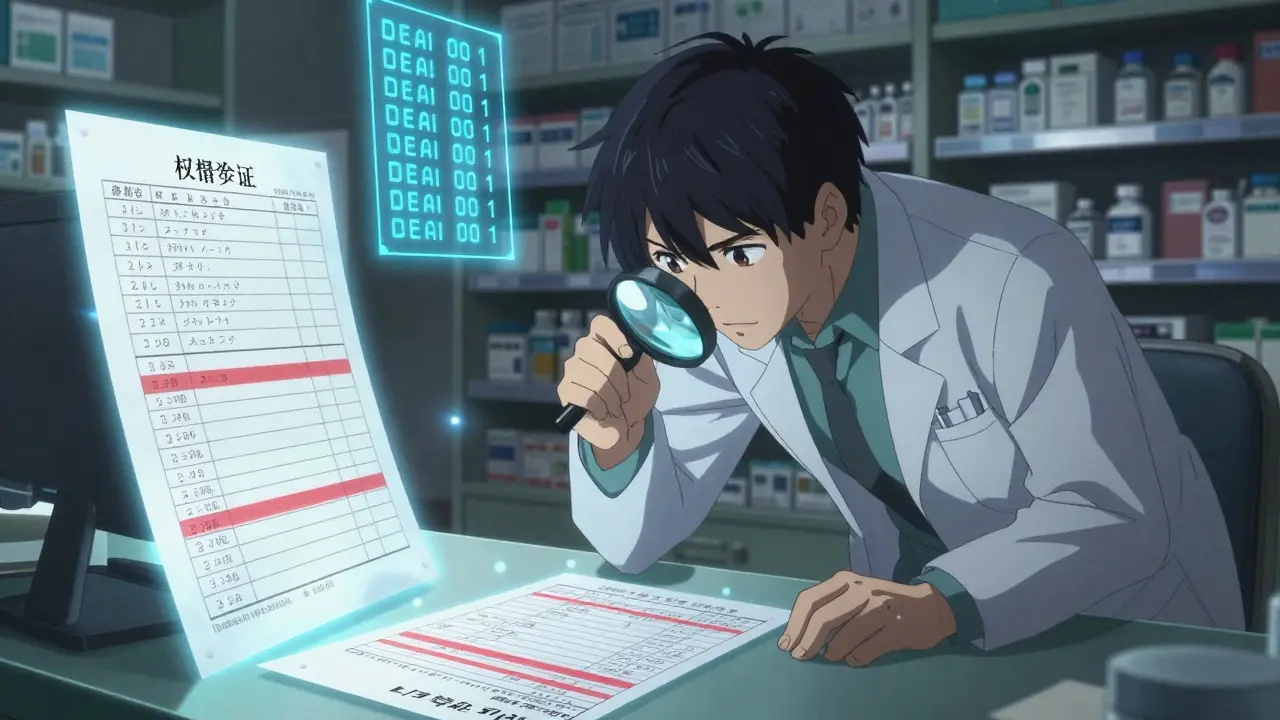
Getting the quantity and directions right on a controlled substance prescription isn’t just good practice-it’s the law. One wrong number, one unclear sig, and you could be looking at license suspension, fines over $750,000, or even criminal charges. The DEA recorded over 6,200 enforcement actions between 2018 and 2023 because of verification failures. Most of these weren’t intentional fraud-they were simple mistakes in checking the basics.
What You Must Verify on Every Controlled Prescription
There are seven non-negotiable elements on every Schedule II-V prescription. Missing or misreading any one of them puts you at risk. These aren’t suggestions-they’re federal requirements under 21 CFR § 1306.05.
- Prescriber’s full name and address: No abbreviations. If it says “Dr. J. Smith, 123 Main St,” and the DEA registration is under “Johnathan Smith,” that’s a red flag.
- Date of issuance: Schedule II prescriptions must be dated the day they’re written. For Schedules III-V, they can’t be older than six months.
- Patient’s full name and address: Match this exactly to the pharmacy’s records. Typos happen-“Jenifer” instead of “Jennifer” isn’t minor if it’s a controlled substance.
- Drug name and strength: Is it oxycodone 5 mg or 10 mg? Is it hydrocodone/acetaminophen 5/325? Don’t assume. Read it twice.
- Dosage form: Tablet, capsule, liquid, patch? This affects how you dispense and what you charge.
- Quantity prescribed: This is where most errors happen. Always check that the numerical amount matches the written-out version. “30 tablets” must equal “thirty (30).” CMS data shows 2% of Medicaid rejections in 2022 were due to mismatched quantities.
- Directions for use (sig): “Take one by mouth every 6 hours as needed for pain” is clear. “Take 1 qid prn pain” is acceptable. “Take 1 TID for 30 days” is not-how many pills total? The sig must allow you to calculate the exact quantity dispensed.
How to Verify the DEA Number (The 3-Step Math)
Every prescriber has a DEA number. But 98.7% of fake DEA numbers can be caught with a simple three-step math check. You don’t need software-just a calculator and a second look.
Take this example: AB1234567
- Check the second letter: It must match the prescriber’s last name initial. If the prescriber is Dr. Smith, the second letter must be ‘S.’ If it’s ‘B,’ stop. Call the prescriber.
- Add the 1st, 3rd, and 5th digits: 1 + 3 + 5 = 9
- Add the 2nd, 4th, and 6th digits, then multiply by 2: 2 + 4 + 6 = 12 → 12 × 2 = 24
- Add both sums: 9 + 24 = 33
- Compare the last digit: The last digit of your total (3) must match the 7th digit of the DEA number (7). 3 ≠ 7 → Invalid.
This method catches 98.7% of invalid numbers, according to DEA’s 2021 validation study. Don’t skip it-even if the system says it’s valid. Manual checks still save licenses.
Quantity and Sig: The Most Common Pitfalls
Pharmacists spend 42% of their verification time on quantity and directions alone, according to a 2022 University of Michigan study. Why? Because these are the easiest to misread-and the most dangerous to get wrong.
Handwritten prescriptions? 68% of pharmacists say they’re illegible. You’re not alone if you’ve had to call a prescriber three times in one shift. But here’s what you need to know:
- If the quantity is written as “30” but the sig says “Take one every 8 hours for 10 days,” that’s 30 doses. That matches. Good.
- If the quantity is “60” and the sig says “Take one every 12 hours for 30 days,” that’s 60 doses. Still matches.
- If the quantity is “100” and the sig says “Take one daily for 14 days,” that’s 14 doses. You have 86 extra pills. That’s a red flag. Call the prescriber.
For opioids, you must also cross-check with CDC conversion factors. For example:
- Hydrocodone 10 mg = 1x
- Hydromorphone 4 mg = 1x
- Methadone 10 mg = 1x (if daily dose is ≤20 mg)
- Methadone 80 mg = 12x
So if a patient gets a prescription for 120 mg of methadone daily and the prescriber writes “Take 10 mg every 8 hours,” that’s 30 mg per day. That’s fine. But if they write “Take 40 mg every 8 hours,” that’s 120 mg daily-which equals 12x. You must verify this matches their current opioid tolerance. If it doesn’t, you’re dispensing a potentially lethal dose.
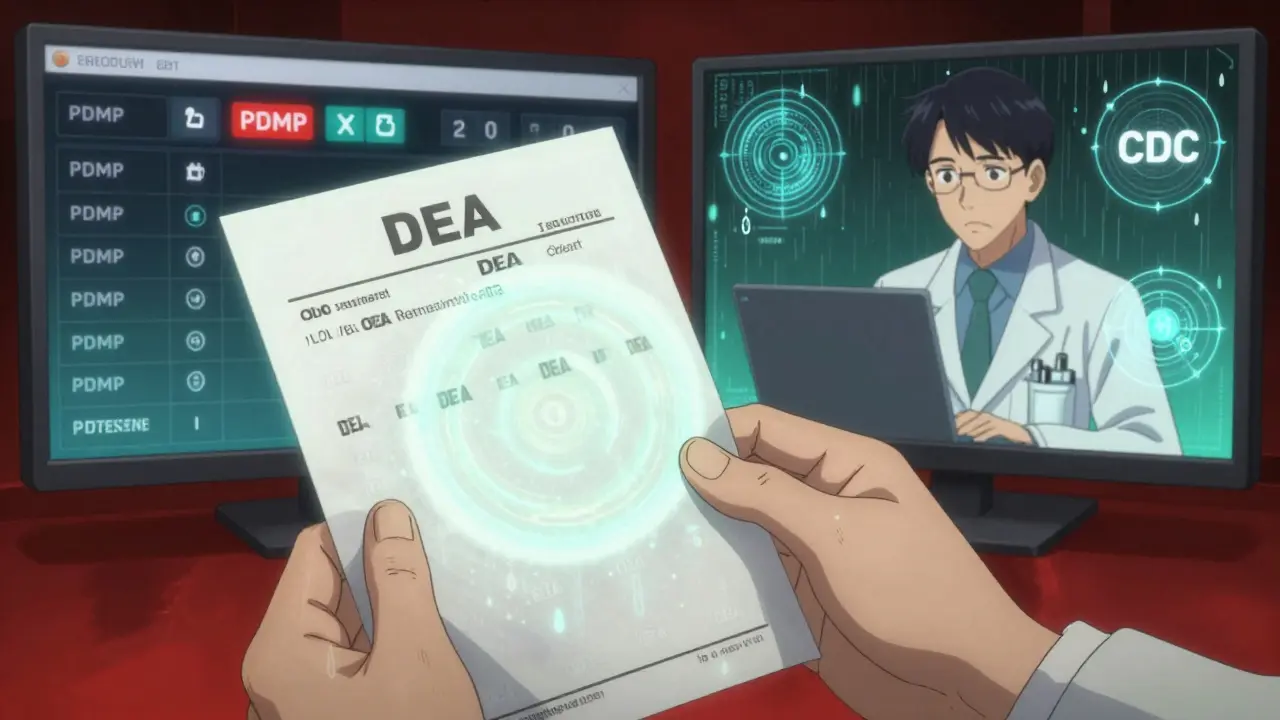
PDMP Checks: What Works, What Doesn’t
Forty-nine states require you to check the Prescription Drug Monitoring Program (PDMP) before dispensing controlled substances. But not all PDMPs are created equal.
Only 27 states require real-time data (under 5 minutes). In 18 states, data can be up to 24 hours old. In four, it’s updated weekly. That means:
- In Tennessee: You pull up the PDMP in 90 seconds. Patient has 12 prescriptions in 30 days. You call the prescriber.
- In California: You wait 22 minutes for the system to load. The data is 18 hours old. You don’t know if the patient got another script yesterday.
DEA reports that delayed PDMP data contributed to 1,247 diversion cases between 2018 and 2023. That’s 14.3% of all investigated cases. Don’t treat PDMP as a checkbox. Treat it as a warning system. If the patient has 3 different prescribers for opioids in 30 days, that’s a red flag-even if the system says “no alerts.”
Electronic Systems vs. Manual Checks
98% of chain pharmacies use electronic verification systems. They’re fast, accurate (99.2%), and required under DSCSA. But they cost $15,000-$50,000 to install. Independent pharmacies? 42% still do it manually.
Here’s the catch: Manual verification has an 18.7% error rate, according to University of Florida research. Electronic systems don’t catch everything. They rely on the data they’re fed. If the prescriber’s DEA number is entered wrong, the system won’t know. If the sig is handwritten and scanned poorly, the OCR will misread “take one qid” as “take one qidq.”
Best practice? Use the system-but verify manually anyway. Double-check the DEA number math. Confirm the quantity matches the sig. Read the directions aloud. If the system says “approved,” but your gut says something’s off-trust your gut. Call the prescriber.
What to Look For: Tamper-Resistant Prescription Features
Since 2008, federal law requires controlled substance prescriptions to have tamper-resistant features. If you’re still seeing a plain paper prescription without these, it’s a red flag:
- Microprinting: Under 10x magnification, you should see tiny text like “DEA” or “Rx” along the border.
- Security background: Patterns that disappear if photocopied.
- Quantity check-off boxes: Pre-printed boxes in 25-unit increments (e.g., 25, 50, 75). If the prescriber writes “100” outside the box, that’s suspicious.
- Asterisk-bordered fields: The quantity and refill fields should be surrounded by asterisks. If they’re not, the prescription may be altered.
- “Rx is void if more than ___ prescriptions”: This line limits how many times the script can be filled. If it’s blank, that’s a violation.
These aren’t optional. If you dispense a prescription without these features, you’re violating federal law-even if the DEA number and quantity are correct.
What Experts Say: The 5-Point Verification Protocol
Dr. John R. Overstreet, former DEA Diversion Control Director, says: “Single-point verification is insufficient.” He’s right. The American Society of Health-System Pharmacists (ASHP) recommends a five-step protocol:
- DEA number validation (the 3-step math)
- PDMP review (even if it’s delayed)
- Prescription integrity check (tamper features, handwriting, format)
- Direct prescriber contact (if anything’s unclear)
- Clinical appropriateness (CDC conversion factors, patient history, overdose risk)
Pharmacists who use all five steps reduce verification errors by 78%, according to a 2023 NCPA study. That’s not just compliance-it’s patient safety.
What’s Changing in 2025 and Beyond
The DEA announced in May 2024 that all controlled substance prescriptions must include a QR code by 2026. This will link directly to the product’s unique identifier under DSCSA. Think of it like a barcode that tells you exactly where the pill came from, when it was made, and who dispensed it.
AI-assisted verification is already being piloted in 12 states. These systems flag patterns-like a patient getting 10 different opioid scripts from 5 prescribers in 2 weeks. But the AMA warns that automated systems could miss human context. That’s why the DEA still says: “The pharmacist is the final gatekeeper.”
By 2030, pharmacy operational costs will rise by $4,200 per pharmacy annually due to verification requirements. But according to RAND Corporation, those costs will be offset by preventing $12.7 billion in annual healthcare expenses from opioid overdoses and diversion.
Final Checklist: Before You Dispense
Before you hand over that bottle of oxycodone or methadone, run through this:
- Is the prescriber’s name and DEA number correct? (Check second letter + math)
- Is the date valid? (Schedule II = today; III-V = within 6 months)
- Does the patient’s name and address match the profile?
- Does the written quantity match the numerical quantity?
- Can you calculate the total dose from the sig? (e.g., 2 tabs TID × 30 days = 180 pills)
- Is the prescription tamper-resistant? (Microprint, asterisks, check-off boxes)
- Did you check the PDMP? Even if it’s outdated?
- For opioids: Does the daily dose match CDC conversion factors?
- Did you call the prescriber if anything was unclear?
If you answered yes to all nine, you’ve done your job. If you skipped one, you’re gambling with a license-and a life.
What happens if I dispense a controlled substance without verifying the quantity?
You could face civil penalties up to $758,574 per violation under 2023 DEA guidelines, license suspension, or criminal charges. The DEA considers unverified quantities a primary indicator of diversion risk. In 2022, 38% of pharmacies cited for violations had quantity mismatches.
Do I need to verify the DEA number even if the system says it’s valid?
Yes. Electronic systems can have input errors or outdated data. The DEA’s three-step math check catches 98.7% of fake numbers that software misses. Always verify manually as a final step.
What if the prescription is handwritten and I can’t read the sig?
Call the prescriber. Do not guess. In a 2023 survey, 68% of pharmacists reported illegible handwriting as a daily challenge. 41% said they had to call prescribers at least once per shift. It’s part of the job.
Can I use a PDMP from a neighboring state if my state’s system is down?
No. PDMPs are state-specific and often don’t share data. Even if you can access another state’s system, it’s not legally sufficient. Always use your state’s official PDMP. If it’s down, delay dispensing until you can verify through direct prescriber contact.
Are there free resources to learn DEA number verification?
Yes. The DEA offers a free online training module called OSCAR (Online Controlled Substance Registration System). Over 87,000 practitioners completed it in 2023. It includes interactive DEA number validation exercises and is available at dea.gov/oscar.


