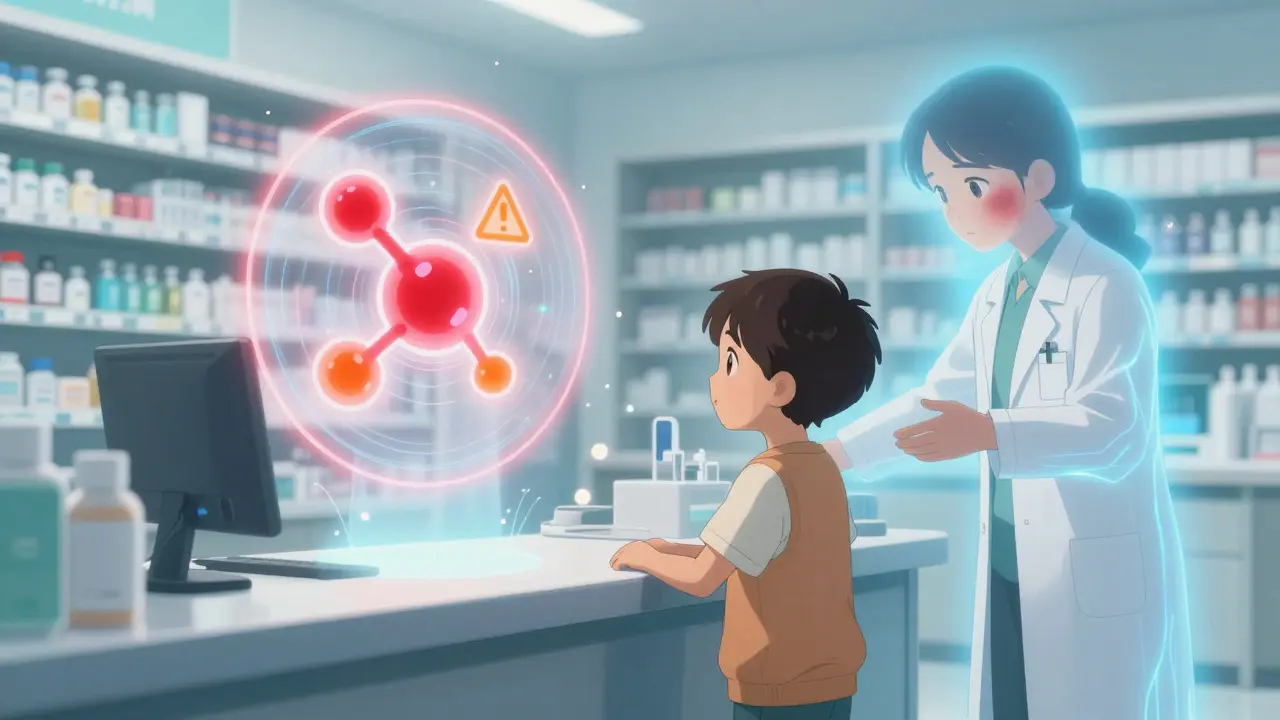
When you pick up a prescription at the pharmacy, you might not think about the silent alarm system working behind the scenes. But if your doctor prescribed amoxicillin and you once had a rash after penicillin, your pharmacy’s computer just triggered a pharmacy allergy alert. These warnings aren’t just noise-they’re meant to keep you safe. But too often, they’re wrong. And when they’re wrong too many times, people stop listening. That’s when the real danger starts.
What Exactly Is a Pharmacy Allergy Alert?
A pharmacy allergy alert is a pop-up warning in the electronic system used by pharmacies and hospitals. It shows up when a medication being prescribed or dispensed might interact with a known allergy in your medical record. The system doesn’t guess-it compares your documented allergies against the ingredients in the new drug using a massive database called a knowledge base. Companies like First DataBank power these systems, and they’re built to catch dangerous matches.
But here’s the catch: these systems don’t just look for exact matches. They also flag related drugs. For example, if you’re listed as allergic to penicillin, the system might warn you about amoxicillin, ampicillin, and even some cephalosporins-even if you’ve taken those before without issue. That’s because the system assumes cross-reactivity: if you react to one drug in a class, you might react to others.
Two Types of Alerts: Definite vs. Possible
Not all alerts are created equal. There are two main kinds:
- Definite allergy alerts: These mean your documented allergy directly matches the drug or its close chemical cousin. For example, your record says "penicillin allergy" and the doctor orders penicillin. This is a clear red flag.
- Possible allergy alerts: These are based on cross-reactivity. The system thinks there’s a chance you might react, even if you’ve never had a problem before. For instance, you’re flagged for cefdinir because you once had a rash after amoxicillin. But here’s the truth: for most people, that risk is extremely low.
Studies show that 90% of all allergy alerts are possible alerts, not definite ones. That means most warnings you see aren’t because you’ve had a bad reaction to this drug-they’re because the system is being overly cautious.
Why So Many Alerts Are Wrong
Let’s say you got sick as a kid after taking penicillin. Your mom said, "You’re allergic." But what you actually had was nausea, diarrhea, or a stomachache. Those aren’t allergies-they’re side effects. Yet, in most medical records, that’s still labeled as an "allergy."
According to research from the American Academy of Allergy, Asthma & Immunology, only 5-10% of reported drug reactions are true immune-mediated allergies. The rest are side effects, intolerances, or coincidences. But EHR systems don’t distinguish between them. They treat every "allergy" label the same.
Even worse, some systems assume blanket cross-reactivity. For example, they might warn you that you can’t take any cephalosporin because you’re "allergic to penicillin." But modern research shows the real cross-reactivity rate between penicillin and later-generation cephalosporins is less than 2%. That’s lower than the chance of being struck by lightning. Yet, 89% of systems still treat it like a 50-50 risk.
What the Alert Tells You (and What It Doesn’t)
When an alert pops up, it should show you three things:
- The drug being prescribed
- Your documented reaction (e.g., "rash," "anaphylaxis," "nausea")
- Why the system thinks there’s a risk (e.g., "penicillin class," "cross-reactivity with cephalosporins")
But here’s what’s missing: context. Did you have a mild rash that faded in two days? Or did you stop breathing and needed epinephrine? Most systems don’t capture severity. Some use color codes-yellow for mild, red for life-threatening-but those are often ignored or misapplied.
At Epic systems, alerts use four tiers: mild (yellow), moderate (orange), severe (red), life-threatening (black). Cerner uses three. But if your record just says "penicillin allergy" without details, the system defaults to the highest possible level. That’s why you get a red alert for a drug you’ve taken five times before.

Why Doctors and Pharmacists Override Alerts
Over 95% of allergy alerts get ignored. That sounds scary-but it’s not because providers are careless. It’s because they’ve learned the system is unreliable.
One study found that 78% of physicians override alerts several times a week. On Reddit, doctors share stories like this: "Got 17 alerts for vancomycin because I once had a stomachache after penicillin at age 8." Another: "System flagged ibuprofen because a patient once had a headache after taking it. That’s not an allergy-that’s a headache."
Even worse, when a real life-threatening reaction is flagged, it’s overridden 75-82% of the time. Why? Because the system is so noisy, providers assume every alert is a false alarm. That’s called alert fatigue-and it’s deadly.
How to Interpret an Alert Correctly
If you’re a patient, you can’t fix the system-but you can understand it. Here’s how to read an alert like a pro:
- Check the reaction. Was it a rash? Hives? Swelling? Trouble breathing? Or was it nausea, dizziness, or a headache? Only the first few are true allergies.
- Ask: "Was this ever tested?" Many people are labeled allergic based on childhood illness. A simple oral challenge under medical supervision can prove you’re not allergic. Up to 90% of people who think they’re allergic to penicillin turn out to be fine.
- Look at the drug class. If the alert says "penicillin class," ask if the drug is actually in that class. Some antibiotics are misclassified. For example, azithromycin is not a penicillin-yet some systems still warn against it.
- Consider timing. True allergic reactions usually happen within minutes to two hours after taking the drug. If you took it days later and got a rash, it’s likely unrelated.
If you’re a provider, the best thing you can do is update your patient’s allergy record with specifics. Instead of "penicillin allergy," write: "Rash 2 days after penicillin at age 7, resolved without treatment." That tells the system it’s not an IgE-mediated reaction-and lowers the alert severity.
The Future: Smarter Alerts, Fewer False Alarms
Change is coming. Major EHR vendors are finally listening.
Epic’s 2023 update introduced "Allergy Relevance Scoring," which uses machine learning to predict which alerts are actually dangerous. At one hospital, this cut low-value alerts by 37%. Oracle Health (formerly Cerner) now pulls data from allergist visits to automatically remove false alerts. If a patient had a drug challenge and proved they’re not allergic, the system quietly turns off the warning.
Also, the 21st Century Cures Act now requires EHRs to capture detailed allergy information-not just a checkbox. More hospitals are training staff to ask: "What happened? When? How bad?" That’s making records more accurate.
Down the road, we’ll see genetic testing integrated into alerts. For example, if you carry the HLA-B*5701 gene, you’re at high risk for a dangerous reaction to abacavir. Systems will soon check that automatically.
What You Can Do Today
You don’t need to wait for technology to fix this. Here’s what you can do:
- Review your allergy list every time you see a doctor. If something doesn’t sound right, say so.
- Ask: "Was this ever confirmed?" If you got a rash once and never had another reaction, it might not be an allergy.
- If you’re told you’re allergic to penicillin, ask about a penicillin allergy test. It’s a simple skin test or oral challenge-and it’s covered by most insurance.
- Don’t assume all drug reactions are allergies. Nausea, fatigue, and headaches are side effects-not allergies.
One woman in Perth came in with a 20-year-old label: "penicillin allergy." She’d taken amoxicillin three times since then without issue. After a simple test, she was cleared. She now takes antibiotics without fear-and her pharmacy no longer flags her for 12 different drugs.
That’s the power of accurate information. Alerts aren’t the problem. Misinformation is.
When to Trust an Alert-and When to Doubt It
Here’s a quick guide:
| Alert Type | Trust It? | Why |
|---|---|---|
| Life-threatening reaction (anaphylaxis, swelling, breathing trouble) | Yes | Always. These are real and rare. |
| "Penicillin allergy" + new penicillin-class drug | Maybe | Check if it’s confirmed. Most aren’t. |
| "NSAID allergy" + ibuprofen | No | Only 12% of these alerts are true allergies. Most are stomach upset. |
| "Cephalosporin allergy" based on penicillin | No | Less than 2% cross-reactivity. Almost always safe. |
| "Allergy" to a drug you’ve taken before | No | If you took it and didn’t react, you’re not allergic. |
Bottom line: Alerts are tools-not rules. They’re meant to help, not scare. The real safety comes from accurate records and smart questions.
What’s the difference between a drug allergy and a side effect?
A drug allergy involves your immune system reacting to the medication, often causing hives, swelling, trouble breathing, or anaphylaxis. Side effects are predictable, non-immune reactions like nausea, dizziness, or headaches. Most people who think they’re allergic to a drug are actually experiencing side effects. Only about 5-10% of reported drug reactions are true allergies.
Can I outgrow a drug allergy?
Yes. Many people, especially those labeled allergic to penicillin as children, lose their sensitivity over time. Studies show up to 90% of people with a documented penicillin allergy are no longer allergic after 10 years. The only way to know for sure is through testing-a simple skin test or oral challenge under medical supervision.
Why do I get allergy alerts for drugs I’ve taken before?
Because your medical record still lists the old reaction, and the system doesn’t know you’ve taken the drug since. Most EHR systems don’t update allergy status automatically. If you’ve taken amoxicillin five times without issue, tell your doctor. Ask them to update your record to say "tolerated" instead of "allergic."
Are all cephalosporins unsafe if I’m allergic to penicillin?
No. Cross-reactivity between penicillin and cephalosporins is less than 2% for third- and fourth-generation versions like ceftriaxone or cefdinir. First-generation cephalosporins like cephalexin have a slightly higher risk (about 5-10%), but even that’s lower than most systems assume. Most allergy alerts for cephalosporins are overblown.
What should I do if I think an allergy alert is wrong?
Don’t just ignore it. Talk to your pharmacist or doctor. Ask: "Is this reaction confirmed? Was it a true allergy or a side effect?" Request a review of your allergy history. If needed, ask for a referral to an allergist for testing. Correcting your record now can prevent unnecessary restrictions on future treatments.
Final Thought: Alerts Are Only as Good as the Data Behind Them
Pharmacy allergy alerts are a powerful tool-but they’re only as smart as the information they’re built on. If your record says "penicillin allergy" without details, the system will treat it like a death sentence. But if it says "mild rash, resolved in 2 days, no recurrence," the alert might not even show up.
The future of safe prescribing isn’t more alerts. It’s better data. And you’re the one who holds that data. Speak up. Ask questions. Update your records. Because the right medication shouldn’t be denied because of a mistake from 20 years ago.


