
The Silent Shift Inside Your Body
Imagine walking into a clinic with your regular prescription, expecting it to work exactly as it did five years ago. Now imagine that same medication sits in your body longer than intended, causing dizziness, confusion, or worse. For many people over sixty-five, this isn't just a hypothetical scenario. Approximately ten percent of all hospital admissions among older adults are directly caused by adverse drug reactions. These reactions often stem from something invisible happening inside the body's filtration systems.
As we age, our bodies undergo quiet but profound structural changes. The liver and kidneys, which act as the primary filters for removing medicines, naturally slow down. While we might think of aging as just getting older, biologically, it is a shift in how our internal machinery processes chemicals. Understanding these changes is essential for anyone managing prescriptions for themselves or a loved one.
Quick Summary
- Liver blood flow decreases by about forty percent in older adults compared to younger people, significantly slowing drug clearance.
- Kidney function declines steadily, with glomerular filtration rate dropping thirty to fifty percent between ages thirty and eighty.
- Phase I enzyme activity reduces significantly, affecting how quickly certain drugs break down in the body.
- Polypharmacy increases risk, with over fourty-one percent of seniors taking five or more daily medications.
- Dose adjustments are often necessary even if lab tests look normal due to reduced muscle mass masking kidney decline.
How the Liver Changes With Age
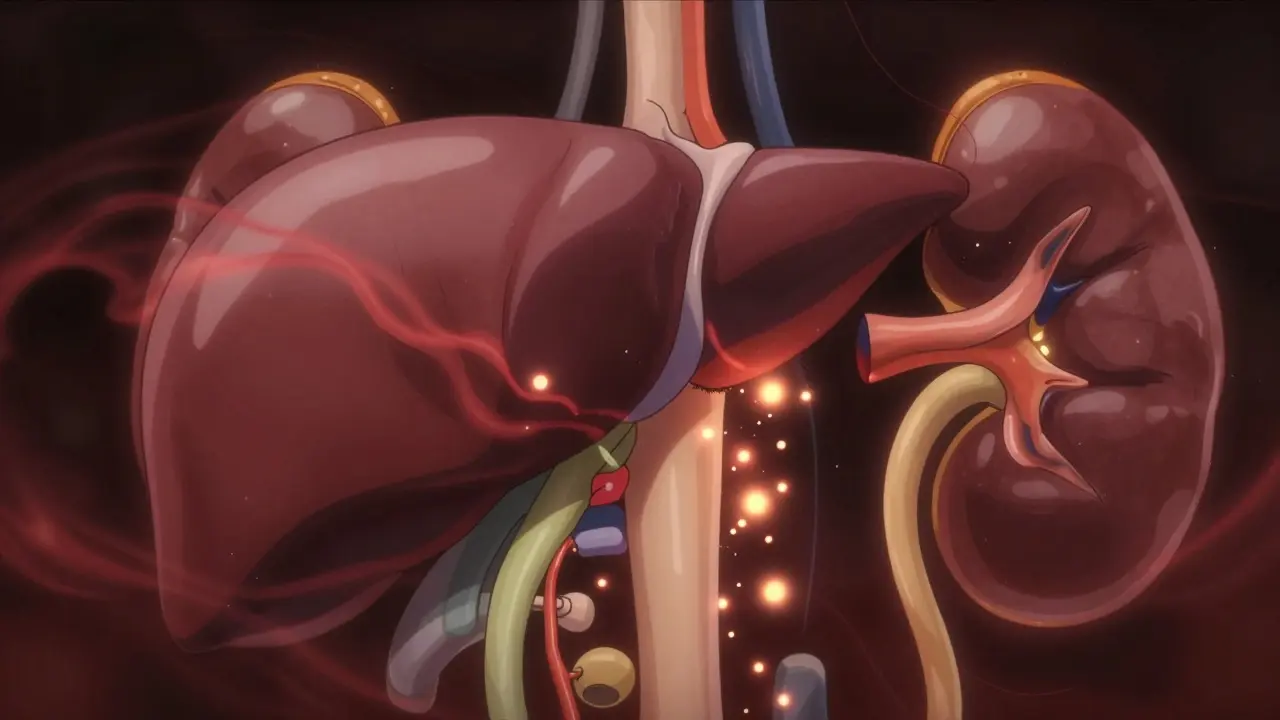
Liver Function The primary organ responsible for drug metabolism and detoxification in the human body acts as the chemical factory of the body. In young adults, blood flows through the liver briskly, picking up toxins and medications to process them. However, this flow slows considerably as we age. Research shows that Hepatic Blood Flow decreases by approximately forty percent in older adults.Think of it like a highway where traffic slows down because the lanes have narrowed. When blood moves slower through the liver, drugs take longer to be broken down. They linger in the bloodstream, reaching higher concentrations than intended. Additionally, the physical mass of the liver shrinks by about thirty percent. This shrinkage isn't uniform; it involves changes in the tiny blood vessels within the liver called sinusoids. These structural alterations impact how efficiently the liver can interact with circulating substances.
The reduction in Cytochrome P450 Enzymes activity is another critical factor. These enzymes are the actual workers that chop up chemical compounds. Studies suggest phase I metabolism generally decreases by thirty-seven to sixty percent in senescence. This means drugs processed by these enzymes accumulate more easily. Interestingly, phase II metabolism remains relatively preserved in humans, meaning some types of conjugation reactions stay stable despite age. This distinction helps doctors decide which medications are safer for geriatric patients.
The Decline in Kidney Clearance
If the liver is the factory, Kidney Health acts as the waste disposal system. As we get older, the filtering capacity of the kidneys diminishes. We measure this ability using the Glomerular Filtration Rate, or GFR. Between the ages of thirty and eighty, the average GFR drops by thirty to fifty percent. That is a massive reduction in cleaning power.
A common pitfall in geriatric medicine is relying solely on serum creatinine levels to judge kidney health. Muscle mass naturally decreases with age. Since muscles produce creatinine, less muscle means lower creatinine in the blood, even if the kidneys aren't working perfectly. This creates a false sense of security. Doctors often use equations like the Modification of Diet in Renal Disease (MDRD) equation or the Cockcroft-Gault equation to estimate true kidney function. Using these estimates is vital for adjusting doses of renally excreted drugs.
Which Medications Are Most Affected?
Not all pills react the same way to these aging organs. Some medications are heavily dependent on blood flow speed, while others depend on enzyme capacity. Scientists categorize these into two groups based on their hepatic extraction ratio.
| Drug Category | Examples | Metabolic Effect | Risk in Seniors |
|---|---|---|---|
| High Extraction (Flow-Limited) | Propranolol, Morphine, Lidocaine | Depends on Liver Blood Flow | High (Clearance drops ~40%) |
| Low Extraction (Capacity-Limited) | Diazepam, Phenytoin, Theophylline | Depends on Enzyme Activity | Moderate (Clearance drops ~10-15%) |
| Renally Excreted | Vancomycin, Digoxin, ACE Inhibitors | Depends on Kidney GFR | Variable (Requires GFR monitoring) |
Drugs like propranolol and verapamil fall into the high extraction category. Because their breakdown relies on blood passing through the liver quickly, the forty percent drop in blood flow hits them hard. Bioavailability for these drugs can increase by twenty-five to fifty percent in seniors, leading to potential overdose symptoms even at standard doses. Conversely, drugs like diazepam rely more on enzyme saturation. Their metabolism stays relatively stable, though they still require caution due to prolonged half-life.
There is also the issue of prodrugs. These are inactive forms that need conversion by the liver to become active. Examples include perindopril. If the liver is sluggish, the drug never fully activates, rendering treatment ineffective. It creates a situation where the patient takes the pill but feels little relief, leading doctors to potentially increase the dose unnecessarily.
Risks of Multiple Medications
Polypharmacy The concurrent use of multiple medications by a patient, typically defined as five or more drugs exacerbates all the physiological changes mentioned above. When you combine slowed liver flow with reduced kidney filtration, adding each new medication increases the complexity exponentially. Statistics show that around forty-one percent of adults aged sixty-five or older use five or more prescription medications within a single month.This creates a perfect storm for interactions. One drug might inhibit the enzyme needed to clear another. For instance, acetaminophen is often considered safe, yet it accounts for roughly fifty percent of acute liver failure cases in older adults when used improperly or combined with other stressors on the liver. The financial cost is staggering too; the U.S. spends approximately thirty billion dollars annually on avoidable hospitalizations linked to inappropriate medication use in older adults.
Safety Tools for Clinicians and Families
We have moved past guessing. There are now established tools designed to guide prescribing for the elderly. The Beers Criteria, updated by the American Geriatrics Society in 2019, provides specific recommendations. It suggests reducing initial doses by twenty to forty percent for drugs metabolized by the liver in patients over sixty-five. For those over seventy-five, further reductions are recommended.
Another powerful tool is the STOPP criteria (Screening Tool of Older Person's Potentially Inappropriate Prescriptions). When implemented, studies show it reduces adverse drug events by twenty-two percent. These guidelines help flag dangerous combinations before they happen. It is particularly useful for spotting medications like amitriptyline, which can cause severe dizziness in seniors due to reduced hepatic clearance, as reported in various case discussions.
Future directions look promising. New pharmacokinetic modeling software like GeroDose v2.1 allows clinicians to simulate drug concentration profiles based on individual factors like weight, age, and enzyme levels. Personalized medicine is shifting toward using biomarkers of organ function rather than just chronological age. This could reduce adverse drug events by thirty-five to fifty percent by the end of the decade if widely adopted.
Why do standard doses hurt older adults?
Standard doses are often calculated for healthy young adults. As liver blood flow drops by forty percent and kidney function declines, the body clears medicines slower. This causes drugs to build up to toxic levels, leading to side effects.
What signs show a drug is building up?
Watch for unexplained confusion, excessive sleepiness, falls, dizziness, or worsening memory. These are common signs of sedatives or painkillers accumulating in the system.
Should I stop all medications if I am old?
No, but review them regularly. Doctors should assess every prescription periodically to ensure it is still necessary and adjust doses based on current kidney and liver health.
Does muscle loss affect kidney tests?
Yes, muscle loss lowers serum creatinine, making kidney function look better than it actually is. Estimates like MDRD equations are needed for accurate assessment.
Are there safer alternatives for heart or pain meds?
Doctors often prefer drugs cleared by kidneys or enzymes less affected by aging. Always ask your doctor if a different medication profile suits your age better.


