
Imagine waking up and feeling like you're looking at the world through a dirty windshield that someone tried to clean with greasy rags. That's exactly how a cataract feels. It isn't a film over your eye, but rather a gradual clouding of the natural lens inside your eye. For millions of people over 40, this is an inevitable part of aging, but it doesn't have to mean losing your independence.
The good news? Modern medicine has turned what was once a terrifying procedure into one of the safest and most successful surgeries on the planet. While the idea of someone touching your eye is nerve-wracking, the reality is a quick outpatient visit that can literally bring the world back into high definition.
Key Takeaways for Your Vision Journey
- What it is: A buildup of proteins in the lens that blocks light and blurs vision.
- The Fix: A quick procedure called phacoemulsification to replace the cloudy lens.
- The Result: Most people regain about 90% of their visual acuity.
- Recovery: Initial improvement happens in 1-3 days, but full healing takes a few weeks.
What Exactly is Happening Inside Your Eye?
Your eye has a natural lens that focuses light onto the retina. As you age, the proteins in that lens start to break down and clump together. Cataracts is the medical term for this progressive clouding of the eye's natural lens. It's a bit like an egg white turning opaque when you cook it; once those proteins change, they can't be "un-clouded" with drops or glasses.
If you've noticed that colors look faded, halos appear around streetlights at night, or you're suddenly squinting more than usual, you're likely experiencing the early stages. While some people develop them due to diabetes or long-term steroid use, for most, it's simply a matter of time. The real problem isn't just the blurriness-it's the loss of contrast and depth perception, which makes things like driving or reading a menu frustrating.
The Modern Solution: Phacoemulsification
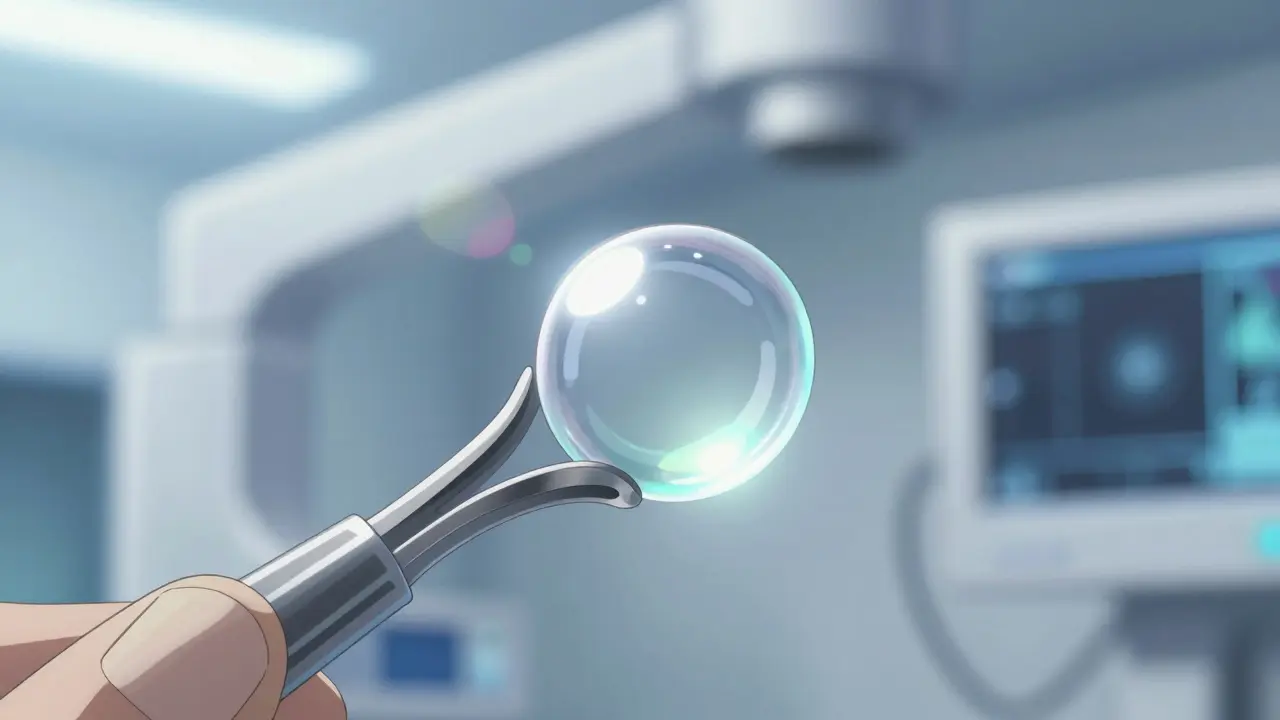
Gone are the days of "couching," an ancient technique where doctors simply pushed the cloudy lens into the back of the eye. Today, the gold standard is Phacoemulsification is a surgical method using an ultrasonic probe to fragment the cloudy lens through a tiny corneal incision.
During the procedure, the surgeon makes a tiny cut-usually between 2.2mm and 2.8mm. They use high-frequency sound waves to break the cataract into tiny pieces, vacuum them out, and then slide in a foldable Intraocular Lens (IOL), which is an artificial lens implanted to replace the eye's natural lens. Once inside, the IOL unfolds and settles into place, acting as your new permanent window to the world.
| Lens Type | Primary Benefit | Trade-off | Estimated Cost (Out-of-Pocket) |
|---|---|---|---|
| Monofocal | Clear distance vision | Need reading glasses for close-up | $1,500 - $3,000 |
| Multifocal/Toric | Corrects astigmatism/near & far | Possible "halos" around lights | $2,500 - $4,500 |
| Trifocal (e.g., PanOptix) | High spectacle independence | Higher cost, longer brain adaptation | Premium pricing |
What to Expect During Recovery
The first few days after surgery are a bit strange. It's common for your eye to feel "scratchy" or itchy. You might see a few blurry spots, which is totally normal as the eye settles. Most people notice a significant jump in clarity within 1 to 3 days, but your brain needs time to adjust to the new way it's receiving light.
One of the most surprising things for patients is the color shift. Because the cataract acted like a yellow-brown filter, everything suddenly looks incredibly vibrant. Some people describe it as seeing the world in "HD" for the first time in years. However, your brain might struggle with depth perception for a while-you might find yourself missing the edge of a table or misjudging a curb.
Recovery isn't an overnight event. While you're mostly functional quickly, full healing can take anywhere from four to ten weeks. During this time, your Ophthalmologist will likely put you on a strict medication schedule. This usually involves antibiotic drops like moxifloxacin to prevent infection and corticosteroids like prednisolone acetate to keep swelling down.

The "Do's and Don'ts" of Post-Op Care
To keep that 98% satisfaction rate, you have to follow the rules. A small mistake in recovery can lead to complications that a surgeon can't easily fix.
Avoid these activities for the first few weeks:
- Heavy Lifting: Straining can increase pressure in the eye, which you definitely want to avoid.
- Rigorous Exercise: No gym sessions or intense sports until your doctor gives the green light.
- Water in the Eye: Keep the shower stream away from your face; you don't want tap water entering the surgical site.
- Driving Immediately: You cannot drive yourself home from the clinic. Your depth perception is off, and your vision is unbalanced.
If you're struggling to adapt, Vision Therapy can be a lifesaver. These are targeted exercises that help your brain and eyes work together again, reducing eye strain and helping you get used to the IOL's focus.
Potential Pitfalls and Long-Term Outlook
While the safety rate is a staggering 99.5%, surgery isn't magic. If you have severe diabetes or Glaucoma, which is a condition of increased pressure damaging the optic nerve, your final visual result might be lower than a healthy eye.
There is also a common long-term issue called posterior capsule opacification. Essentially, the "bag" that holds your new lens can get cloudy again over a few years. If this happens, you don't need another surgery. A quick laser procedure called a YAG Laser Capsulotomy can clear that film in minutes without any incisions.
Will I still need glasses after cataract surgery?
It depends on the lens you choose. If you get a standard monofocal lens, it's usually set for distance vision, meaning you'll likely still need reading glasses for books or phones. Premium multifocal or trifocal lenses can reduce your reliance on glasses, but they don't always eliminate the need entirely.
Is cataract surgery painful?
The procedure itself is painless because it's done under local anesthesia. After the surgery, you might feel some mild discomfort, itchiness, or a "scratchy" sensation for a few days, but this is usually managed with prescribed eye drops.
How long does the surgery actually take?
The actual surgical part is remarkably fast, often taking only 15 to 30 minutes per eye. However, you'll spend more time in the clinic for prep and recovery observations.
What happens if I wait too long to get the surgery?
Waiting until a cataract is "ripe" (extremely dense) can sometimes make the surgery more complex. If the cataract is too hard, it may require more ultrasound energy to break up, which can potentially increase the risk of inflammation or complications during the procedure.
Can cataracts come back after surgery?
No, the cataract itself cannot return because the natural lens has been removed. However, as mentioned, the membrane holding the artificial lens can become cloudy. This is easily fixed with a YAG laser treatment.


