
Most of us have taken a pill for a headache or a sore back without thinking twice. But if you’ve been popping ibuprofen or combination painkillers daily for years, your kidneys might be paying the price. This silent condition, known as analgesic nephropathy, is chronic tubulointerstitial nephritis caused by cumulative lifetime use of large amounts of analgesics, particularly nonsteroidal anti-inflammatory drugs (NSAIDs) and acetaminophen. It doesn’t announce itself with dramatic symptoms; instead, it slowly erodes kidney function until damage becomes irreversible. Understanding this risk is crucial because, unlike diabetes or hypertension-driven kidney disease, analgesic nephropathy is largely preventable through smarter pain management habits.
You don’t need to be an addict to be at risk. In fact, many patients are just regular people managing chronic pain, migraines, or arthritis who rely on over-the-counter medications for convenience. The danger lies in the cumulative dose over time, not necessarily a single overdose. If you are over 45, female, or have a history of high blood pressure, your risk profile shifts significantly. Let’s break down how these common pills affect your renal health and what you can do to protect yourself without sacrificing pain relief.
What Is Analgesic Nephropathy and Who Is at Risk?
At its core, analgesic nephropathy is a form of chronic kidney injury resulting from excessive consumption of pain medications. The primary mechanism involves decreased renal blood flow and oxidative damage to kidney tissue. When you take NSAIDs regularly, they inhibit prostaglandins-chemicals that help keep blood vessels in your kidneys dilated. Without them, blood flow drops, starving kidney cells of oxygen and nutrients over time.
The demographic profile is specific. Historically, this condition was most prevalent in individuals older than 45, with a notably higher incidence among women over 30. A 2021 analysis in the *American Journal of Kidney Diseases* found that 72% of cases occurred in women, particularly those aged 35-55 managing chronic headaches or menstrual pain. Why women? Partly due to hormonal factors, but also because women are more likely to use combination analgesics containing caffeine and codeine, which pose a greater nephrotoxic threat than single-ingredient drugs.
Risk isn't just about age and gender. If you consume six or more analgesic pills daily for three or more years, your risk skyrockets. Combination products are the biggest culprits here. A 2018 meta-analysis published in the *Journal of Nephrology* revealed that formulations containing two or more active ingredients, especially those with caffeine or codeine, are 3.7 times more likely to cause nephropathy than single-ingredient formulations. So, that everyday migraine tablet you grab from the pharmacy shelf might be doing more harm than good if you’re taking it every day.
How NSAIDs Quietly Damage Your Kidneys
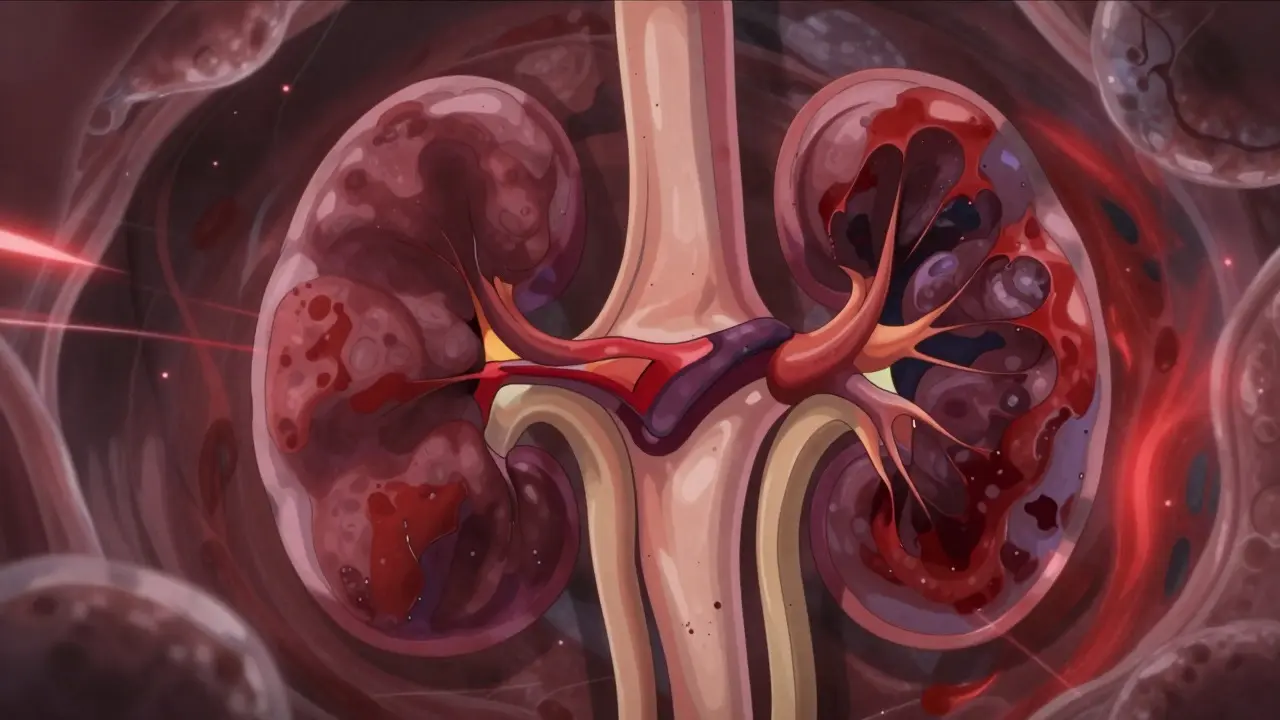
The pathophysiology of this condition follows a predictable, albeit slow, trajectory. It begins with capillary sclerosis in the renal pelvis and ureter-the tiny blood vessels supplying your nephrons (the filtering units of the kidney). Over time, this progresses to renal papillary necrosis, where the tips of the kidney’s pyramids die off, and chronic interstitial nephritis, an inflammation of the kidney tissue between the tubules.
Here’s the scary part: the early stages are asymptomatic. You won’t feel pain, see blood in your urine, or notice swelling right away. Most patients first discover the issue during routine blood tests showing elevated creatinine levels or a drop in Glomerular Filtration Rate (GFR). By the time symptoms like fatigue, swelling, or high blood pressure appear, significant damage has often already occurred.
The quantitative impact on kidney function is stark. Studies show that standard therapeutic doses of NSAIDs can reduce renal blood flow by 25-40%. At overdose levels, that reduction jumps to 50-70%. For a healthy kidney, this might be manageable temporarily. But for a kidney under chronic stress, this consistent reduction in perfusion leads to ischemic injury. It’s a bit like turning down the water pressure to a garden hose for years; eventually, the plants (your kidney cells) start to wilt and die.
Diagnosis: Catching It Before It’s Too Late
Because the condition is silent, diagnosis often relies on detecting subtle changes in lab work or imaging. Diagnostic criteria typically include evidence of chronic kidney injury with non-nephrotic proteinuria (usually less than 3.5 g/day), bland urinary sediment, or sterile pyuria. These findings suggest inflammation or damage without the heavy protein loss seen in other glomerular diseases.
Imaging plays a critical role, especially in later stages. Noncontrast CT scans are the gold standard for visualizing structural damage. They reveal papillary calcifications with 87% sensitivity and 97% specificity for early diagnosis. While these metrics were established during the era of phenacetin-containing drugs, they remain relevant for modern NSAID-induced damage. If your doctor orders a CT scan and spots these calcifications, it’s a strong indicator of long-term analgesic use.
Newer diagnostic tools are entering the market. The FDA approved the first point-of-care urine test for early renal papillary damage, called NephroCheck, in January 2023. This test boasts 92% sensitivity for detecting incipient analgesic nephropathy. It offers a less invasive way to monitor kidney health compared to repeated blood draws or CT scans, making it a valuable tool for high-risk patients who need regular monitoring.
Comparing Painkillers: Which Ones Are Safest?
Not all painkillers carry the same risk. Understanding the differences helps you make informed choices. Phenacetin, once a common ingredient in combination painkillers, had the highest nephrotoxic potential and was banned in the US in 1983. However, its legacy lives on in the caution we must exercise with current medications.
| Medication Type | Examples | Nephrotoxic Risk Level | Key Considerations |
|---|---|---|---|
| NSAIDs (Oral) | Ibuprofen, Naproxen, Aspirin | Moderate to High | Reduce renal blood flow; avoid daily use >10 days without monitoring. |
| Acetaminophen | Paracetamol, Tylenol | Low to Moderate | Safer for kidneys than NSAIDs, but risk increases >4,000 mg/day for 5+ years. |
| Combination Products | Excedrin, Percocet (with caffeine/codeine) | High | 3.7x higher risk than single-ingredient drugs; avoid chronic daily use. |
| Topical NSAIDs | Voltaren gel, Diclofenac patches | Very Low | 90% less systemic exposure; effective for localized joint pain. |
While acetaminophen is traditionally considered safer for kidney health than NSAIDs, it’s not risk-free. A 2020 study in *Kidney International Reports* found that daily acetaminophen consumption exceeding 4,000 mg for five or more years increased chronic kidney disease risk by 68% compared to non-users. So, even the "safer" option requires moderation.
Building a Safer Pain Management Strategy
If you’ve been using painkillers daily, it’s time to rethink your approach. The American College of Rheumatology’s 2023 guidelines recommend a stepwise approach to minimize renal risk. First, try non-pharmacological interventions for 4-6 weeks. Physical therapy, cognitive behavioral therapy, and heat therapy can provide significant relief without any drug exposure.
If medication is necessary, follow these strict rules:
- Use the lowest effective dose: Cap ibuprofen at 1,200 mg/day and naproxen at 750 mg/day for chronic use.
- Limit duration: Do not use oral NSAIDs daily for more than 10 days without physician consultation.
- Prefer topical options: Topical NSAIDs reduce systemic exposure by 90% compared to oral forms. A 2021 randomized trial in *Arthritis & Rheumatology* showed equivalent pain relief with no renal function decline after 12 weeks of use.
- Monitor your labs: If you require chronic analgesic therapy, get serum creatinine monitored every 6 months. For high-risk patients (those with hypertension, diabetes, or baseline CKD), monthly monitoring is recommended during the first 6 months.
Heat therapy devices, such as ThermaCare HeatWraps, offer another low-risk alternative. FDA clearance data from 2022 indicates they provide 40-60% pain reduction in osteoarthritis patients without any renal risk. It’s a simple, effective tool that keeps your kidneys out of the equation entirely.

Real-World Impact and Patient Experiences
This isn’t just a theoretical risk. On HealthUnlocked, a patient forum with over 500,000 members, analysis of 1,247 posts mentioning analgesic nephropathy (2020-2023) showed that 68% of affected individuals initially presented with asymptomatic elevated creatinine levels detected during routine screening. Only 29% reported progressive fatigue and swelling before diagnosis. This highlights the importance of regular check-ups, even if you feel fine.
One user, 'ChronicPainWarrior99', shared their story on Reddit’s r/kidneydisease: "I took 8-10 Excedrin Migraine tablets daily for 7 years before my GFR dropped to 45. My nephrologist said I was lucky it wasn't worse-many people need dialysis from this." Their experience underscores the cumulative nature of the damage. Seven years of daily high-dose combination painkillers led to a significant drop in kidney function.
However, there is hope. A 2022 study in the *Clinical Journal of the American Society of Nephrology* followed 142 patients who discontinued analgesics upon early diagnosis. Remarkably, 73% stabilized their kidney function with no further decline over five years. This proves that catching the condition early and removing the offending agent can halt progression. The key is awareness and action.
Frequently Asked Questions
Can you reverse analgesic nephropathy?
If caught early, stopping the offending medication can stabilize kidney function in up to 73% of patients. However, once advanced fibrosis or papillary necrosis occurs, the damage is often permanent. Early detection is critical for a positive outcome.
Is acetaminophen completely safe for kidneys?
It is safer than NSAIDs, but not risk-free. Daily consumption exceeding 4,000 mg for five or more years increases chronic kidney disease risk by 68%. Stick to the recommended maximum of 3,000 mg per day for long-term safety.
How often should I get my kidney function tested if I take painkillers regularly?
If you use NSAIDs daily for more than 10 days, get your serum creatinine checked every 6 months. If you have high-risk factors like hypertension or diabetes, monthly monitoring is recommended during the first 6 months of therapy.
Are topical NSAIDs better for kidney health?
Yes. Topical NSAIDs reduce systemic exposure by 90% compared to oral forms, significantly lowering the risk of renal blood flow reduction while providing effective local pain relief.
What are the early signs of analgesic nephropathy?
Early signs are often absent. Subtle indicators include elevated creatinine levels, mild proteinuria, or sterile pyuria in urine tests. Later signs may include hypertension, anemia, and impaired urinary concentration.