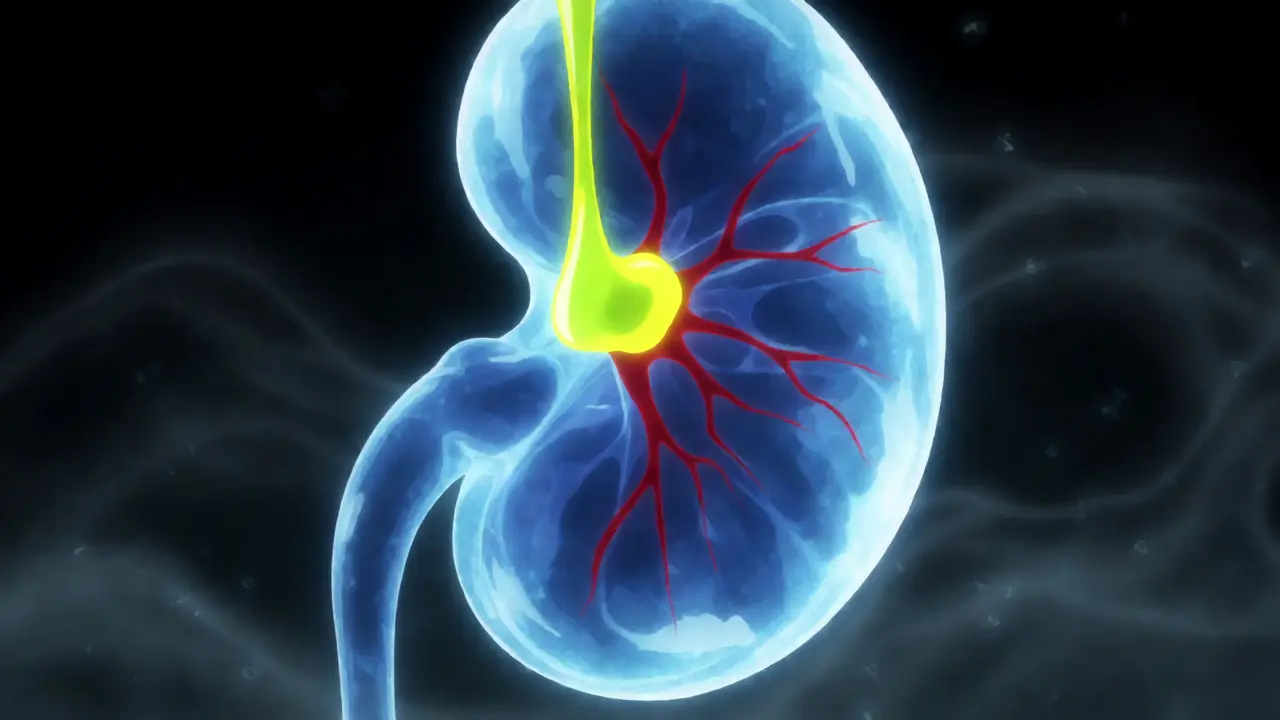
Imagine you have chronic kidney disease (CKD). Your kidneys are already working overtime just to keep your blood clean. Then, you get sick or need a scan with dye, and suddenly, your kidney function crashes. This is Acute Kidney Injury (AKI) on Chronic Kidney Disease. It’s a dangerous combo that can turn a manageable condition into a life-threatening emergency. If you or someone you love has reduced kidney function, knowing how to avoid the two biggest triggers-contrast media and certain medications-is non-negotiable.
This isn't just about being cautious; it's about understanding the mechanics of damage. When kidneys are already compromised, they lose their ability to regulate blood flow and filter toxins efficiently. Add in a chemical stressor like iodinated contrast or a drug like an NSAID, and the remaining functional tissue gets overwhelmed. The goal here is simple: prevent further loss. Because once you lose significant kidney mass, it rarely comes back. Let’s break down exactly what puts these vulnerable kidneys at risk and how to shield them.
Why AKI on CKD Is a High-Stakes Game
People often think of kidney disease as a slow, steady decline. But for those with existing Chronic Kidney Disease (CKD), an acute hit can be catastrophic. According to the American Academy of Family Physicians, about 7% of hospitalized patients develop AKI, but in intensive care units, that number jumps to nearly two-thirds. For patients who already have CKD stages 3-5 (where estimated glomerular filtration rate, or eGFR, is below 60 mL/min/1.73m²), the risk skyrockets.
Why? Because healthy kidneys have a "reserve." They can handle a bit of abuse. Damaged kidneys don’t. When serum creatinine rises by just 0.3 mg/dL within 48 hours, or urine output drops significantly, we call it AKI. In a patient with CKD, this acute drop can push them permanently into dialysis territory. A 2021 meta-analysis showed that roughly 30% of AKI episodes in CKD patients lead to permanent function decline, and 10-15% progress to end-stage renal disease within five years. That’s not a small statistic-it’s a life-altering shift.
The Danger of Contrast Media
You’ve likely heard of CT scans using "dye." That dye is usually iodinated contrast media. While modern agents are safer than older versions, they still pose a threat known as Contrast-Induced Acute Kidney Injury (CI-AKI). In the general population, CI-AKI occurs in 1-15% of cases. But if you have diabetes plus CKD, that incidence climbs to 20-50%. If you also have heart failure, add another layer of risk.
The mechanism involves vasoconstriction (narrowing of blood vessels) in the kidney medulla and direct toxicity to tubular cells. The KDIGO Guidelines (Kidney Disease: Improving Global Outcomes) are clear: avoid IV iodinated contrast when possible. If it’s essential, use the lowest dose-typically under 100 mL-and ensure aggressive hydration.
| Risk Factor | Incidence Rate | Action Required |
|---|---|---|
| General Population | 1-15% | Standard precautions |
| CKD Stage 3-5 (eGFR <60) | 12-50% | Hydration + Dose reduction |
| Diabetes + CKD | 20-50% | Nephrology consult recommended |
| Heart Failure + CKD | 15-35% | Careful fluid management |
| Volume Depletion | 10-25% | Pre-hydration critical |
Hydration is the cornerstone of prevention. The standard protocol involves isotonic saline (normal saline) at 1.0-1.5 mL/kg/hour for 6-12 hours before and after the procedure. Avoid hyperoncotic solutions like hydroxyethyl starch or albumin for resuscitation-they offer no benefit and may harm. Also, forget dopamine; studies show it doesn’t protect kidneys and should not be used for prevention.
Nephrotoxic Medications: The Silent Killers
While contrast gets the headlines, everyday medications cause more frequent damage. Pharmacists play a huge role here, identifying risks that doctors might miss during busy shifts. Interventions by pharmacists have been shown to reduce AKI incidence by 22% in hospitalized CKD patients. So, which drugs should you worry about?
NSAIDs: The Most Common Culprit
Nonsteroidal Anti-Inflammatory Drugs (NSAIDs) like ibuprofen, naproxen, and diclofenac are notorious. They block prostaglandins, which normally help dilate the afferent arterioles (blood vessels entering the kidney). Without this dilation, blood flow to the kidney drops. In CKD patients, NSAID use increases AKI risk by 2.5-fold. If you have a headache or joint pain, acetaminophen (paracetamol) is generally safer for your kidneys, though liver health must be considered.
Antibiotics and Antifungals
Not all antibiotics are created equal. Some are directly toxic to kidney tubules:
- Aminoglycosides (e.g., gentamicin): Nephrotoxicity occurs in 10-25% of courses. Monitoring levels is crucial.
- Vancomycin: Risk rises sharply if trough levels exceed 15 mcg/mL. Nephrotoxicity rates vary from 5-40% depending on duration and concurrent meds.
- Amphotericin B: An antifungal with high toxicity (30-80% incidence). Lipid formulations are preferred to reduce this risk.
ACE Inhibitors and ARBs
Drugs like lisinopril or losartan are great for long-term kidney protection in stable CKD. However, during an acute illness (like severe vomiting or diarrhea), they can worsen AKI. These drugs affect renal autoregulation. Abruptly stopping them can sometimes cause a rebound increase in blood pressure, but continuing them during dehydration can starve the kidneys of blood flow. It’s a delicate balance requiring close monitoring.
Management Strategies and Prevention Protocols
If AKI strikes while you have CKD, time is of the essence. The KDIGO guidelines emphasize adjusting medication doses based on current kidney function, not your baseline CKD stage. Many renally cleared drugs accumulate quickly, leading to toxicity.
One common misconception is the use of diuretics to "flush out" the kidneys. Unless you are volume overloaded (swelling due to excess fluid), diuretics do not improve outcomes and can actually worsen AKI by causing dehydration. Similarly, renal vasodilators like fenoldopam have failed to show benefit in preventing CI-AKI.
What about supplements? N-acetylcysteine (NAC) was once hailed as a miracle preventative for contrast injury. Current evidence is conflicting, with some studies showing a 15-30% risk reduction and others showing none. It’s low-risk, so many clinicians still use it, but don’t rely on it alone. Hydration remains king.
Biomarkers are changing the game. Traditional creatinine tests lag behind actual damage. Newer markers like TIMP-2 and IGFBP7 can predict AKI up to 12 hours before creatinine rises, offering a window for early intervention. While not yet standard everywhere, ask your doctor if these tests are available in complex cases.
Patient Education: Your Role in Protection
You are the first line of defense. Studies show that CKD patients who receive specific counseling on avoiding NSAIDs and maintaining hydration have 25% lower rates of AKI hospitalization. Here’s your checklist:
- Read Labels: Check cold and flu meds for hidden NSAIDs.
- Stay Hydrated: Especially during illness, heat, or exercise. Don’t wait until you’re thirsty.
- Inform Providers: Always tell radiologists and surgeons about your CKD status and recent labs.
- Monitor Weight: Sudden weight gain can signal fluid retention; sudden loss can signal dehydration.
Remember, electronic health record alerts help, but they aren’t perfect. Clinicians sometimes override warnings due to alert fatigue. Don’t assume the system caught it-speak up.
Frequently Asked Questions
Can I ever take NSAIDs if I have CKD?
Generally, no. NSAIDs significantly increase the risk of acute kidney injury in CKD patients. Occasional, short-term use under strict medical supervision might be acceptable for some, but chronic use is strongly discouraged. Acetaminophen is usually a safer alternative for pain relief.
Is MRI contrast safer than CT contrast for kidneys?
MRI uses gadolinium-based contrast agents, which are different from iodinated CT contrast. Gadolinium carries a risk of nephrogenic systemic fibrosis (NSF) in patients with severe kidney failure (eGFR <30), but it does not typically cause the same type of acute tubular necrosis seen with iodinated contrast. Newer macrocyclic gadolinium agents are considered very safe, even in moderate CKD.
Should I stop my ACE inhibitor if I get sick?
This depends on the severity of your illness. During acute illnesses involving dehydration (vomiting, diarrhea, fever), doctors often recommend temporarily holding ACE inhibitors or ARBs to prevent AKI. This is known as "sick day rules." Always consult your healthcare provider for personalized advice rather than stopping abruptly without guidance.
How much water should I drink before a CT scan?
For high-risk CKD patients, protocols vary, but a common recommendation is intravenous hydration with normal saline at 1.0-1.5 mL/kg/hour for 6-12 hours before and after the scan. Oral hydration alone may not be sufficient for high-risk individuals. Follow your radiology department's specific instructions.
Does drinking cranberry juice help prevent kidney issues?
Cranberry juice may help prevent urinary tract infections, but there is no strong evidence that it prevents contrast-induced AKI or protects against nephrotoxic drugs. Rely on proven methods like hydration and medication adjustment instead.
Next Steps for You
If you have CKD, schedule a review with your nephrologist or primary care physician specifically about your medication list. Ask them to flag any potential nephrotoxins. Before any imaging test involving contrast, request a discussion on alternatives or protective measures. And finally, keep a personal log of your symptoms and lab results. Knowledge is power, and in the world of kidney health, it’s also preservation.